Medically reviewed by Dr. Jinhag Baik, MD · Last updated September 2026
Children, Myopia & Screen Time in Seoul: When to Book a Myopia Check
Squinting at the TV or glued to a tablet? A board-certified ophthalmologist in Guro explains the warning signs, the evidence, and how to slow myopia.
Quick Answer
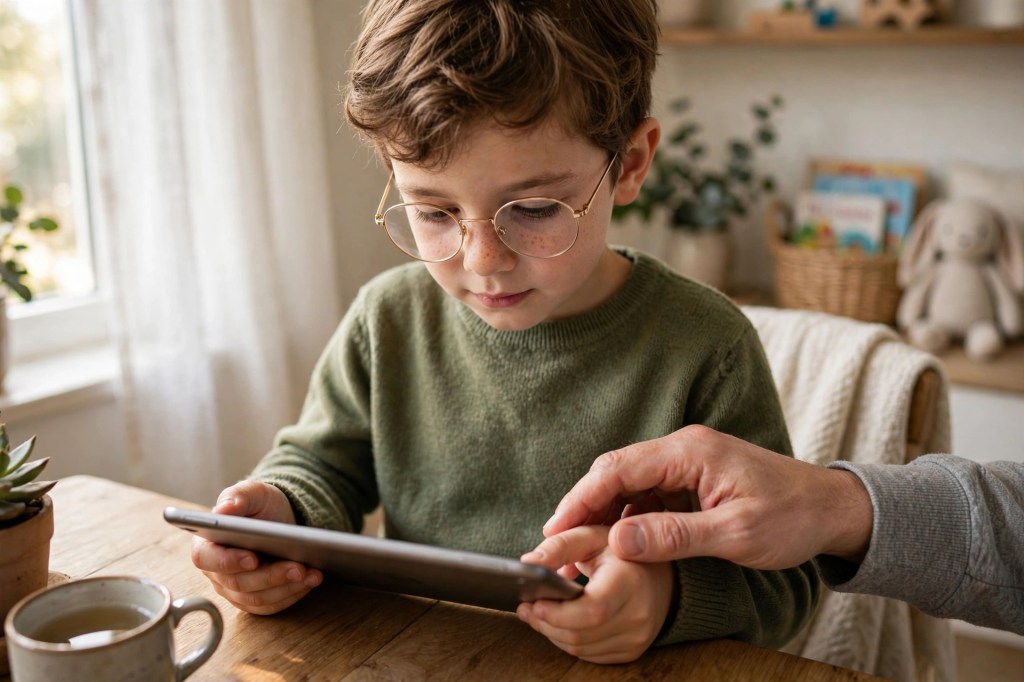
Book a myopia check if your child squints, sits close to screens or struggles to read the board — and in any case have a first full eye exam by age 3–4, then yearly checks through school. Research on children, myopia and screen time in Seoul and worldwide shows that heavy near-work and device use, combined with little outdoor time, are linked to earlier and faster myopia. At Nunehim Eye Center in Guro, families from Yeongdeungpo, Gasan and Gwanak can get a cycloplegic (dilated) eye exam and discuss myopia control options such as OK lenses and low-dose atropine.
Q. How are children, myopia and screen time connected in Seoul?
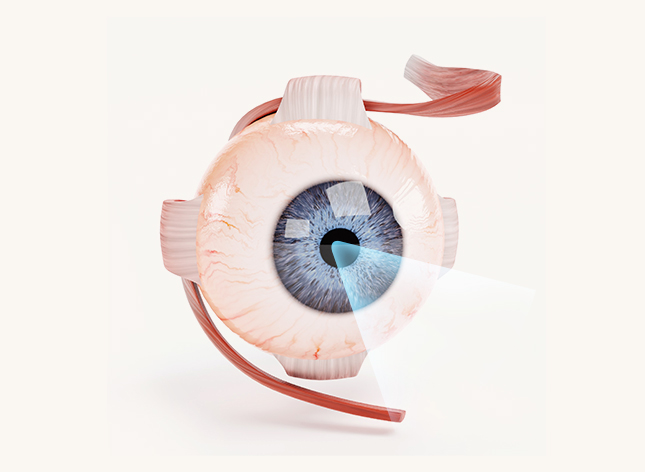
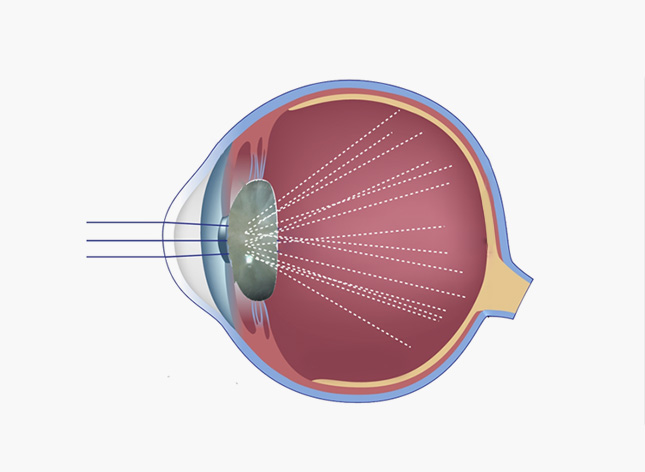
Myopia (nearsightedness) happens when the eyeball grows too long, so distant objects focus in front of the retina instead of on it. Parents asking about children, myopia and screen time in Seoul are right to pay attention: Korea has some of the highest childhood myopia rates in the world. Genetics play a role — children with two myopic parents are at much higher risk — but environment matters just as much.
Large studies, including a 2021 meta-analysis in The Lancet Digital Health, link smartphone and tablet use to roughly 30% higher odds of myopia, and higher still when combined with computer use. The likely mechanism is prolonged close focus plus, critically, time taken away from outdoor light. Bright daylight is thought to stimulate retinal dopamine that slows eye growth; every extra hour indoors on a device is an hour without that protection.
In neighbourhoods like Yeongdeungpo, Gasan and Gwanak, where many children move from school to hagwon to homework with little daylight in between, early detection is especially valuable.
Q. What are the signs my child needs a myopia check?
- Squinting or narrowing the eyes to see the TV, whiteboard or distant signs
- Holding phones, tablets or books very close to the face
- Sitting at the front of the classroom or close to the TV
- Frequent eye rubbing, headaches or tiredness after reading or screen time
- Covering one eye or tilting the head to see
- Falling grades or losing interest in activities that need distance vision
- A school screening note, or a parent with high myopia
📊 Childhood Myopia in Korea
▸ Korean national survey data (KNHANES) suggest roughly two in three children and teenagers aged 5–18 are myopic.
▸ In a Seoul study of 19-year-old men, about 96% were myopic and over 20% had high myopia.
▸ About half of the world’s population is projected to be myopic by 2050, up from roughly a quarter in 2000.
▸ School-based trials in East Asia show extra outdoor time reduces new myopia; many experts advise about 2 hours outdoors every day.
▸ Seoul families report some of the highest average daily study and screen hours among school-age children, contributing to the myopia burden.
Q. How can myopia progression be slowed in children?
Correcting blurry vision with glasses is only the first step. Because every dioptre of myopia raises the lifetime risk of retinal detachment, myopic maculopathy and glaucoma, modern paediatric eye care focuses on myopia control — slowing how fast the eye grows. Evidence-based options include low-dose atropine eye drops, orthokeratology (OK lenses) worn overnight, and myopia-control spectacle lenses or soft contact lenses.
At Nunehim Eye Center, OK lens fitting is one of our specialties. OK lenses gently reshape the cornea during sleep so children can see clearly during the day without glasses, and studies show they slow axial eye growth by roughly 30–50% on average compared with single-vision glasses. We measure axial length at follow-up visits in Guro so parents can see objectively whether treatment is working.
Q. What screen time habits protect children’s eyes?
Screens are part of modern school life, so the goal is balance, not a ban. Useful rules: follow the 20-20-20 rule (every 20 minutes, look at something 20 feet / 6 m away for 20 seconds); keep devices at least 30–40 cm from the eyes; prefer larger screens such as a TV or laptop over phones; avoid screens in the dark; and — most importantly — aim for about 2 hours outdoors every day. The WHO advises no sedentary screen time for children under 2 and no more than 1 hour a day for ages 2–4. Weekend time along the Anyangcheon stream in Guro or Yeongdeungpo, or a family hike on Gwanaksan, all counts.
Q. When should I see a doctor in Seoul?
Book a paediatric eye exam promptly if:
- Your child is 3 or older and has never had a full eye exam
- Glasses prescriptions are changing by −0.50 D or more per year
- Myopia started before about age 8–9 (earlier onset usually means faster progression)
- Both parents are myopic, especially highly myopic
- Your child reports sudden blur, double vision, a turning eye, or flashes and floaters
- A school screening or national infant health check flags a vision problem
Cycloplegic (dilated) refraction is the most reliable way to measure a child’s true prescription — we perform it routinely for families from Gasan, Gwanak, Yeongdeungpo and Guro.
Q. What eye checks does my child need at each age?
Ages 3–5: First full exam
Check for amblyopia (lazy eye), strabismus and significant refractive error. Lazy eye treatment works best when started early, ideally before about age 7–8.
Ages 6–12: Yearly checks
This is when myopia usually appears and progresses fastest. Annual cycloplegic refraction and axial length measurement guide timely myopia control.
Teens: Monitor & protect
Progression usually slows in the late teens. Continue yearly checks; laser vision correction such as TransPRK is only considered once the prescription is stable in adulthood.
“Myopia control is a window that closes.”
Parents often tell me they wish they had come a year earlier. Once the eye has grown longer, we cannot shrink it back — but in younger children we can meaningfully slow that growth. If your child is squinting at screens or struggling to read the board, a simple dilated eye exam tells us where they stand and whether OK lenses or atropine would help.
— Dr. Daniel Baik, board-certified ophthalmologist, Nunehim Eye Center
❓ Frequently Asked Questions
Q. Does screen time directly cause myopia?
Screen time is strongly associated with myopia, but the effect is likely a combination of prolonged close focus and less outdoor time rather than the screen itself. Reducing close-up device use and increasing daylight exposure both help.
Q. At what age should my child have their first eye exam?
A full eye exam by age 3–4 is recommended, or earlier if you notice squinting, an eye turn or a family history of significant eye problems. After that, check yearly through school age.
Q. Do blue-light glasses prevent myopia in children?
There is no good evidence that blue-light filtering glasses prevent or slow myopia. Outdoor time, screen breaks and proven myopia-control treatments are far more effective.
Q. Are OK lenses safe for children?
When fitted and monitored by an eye doctor with strict lens hygiene, orthokeratology has a good safety record. The main risk is corneal infection, so careful cleaning routines and regular check-ups are essential.
Q. Do glasses make myopia worse?
No. Properly prescribed glasses do not make myopia progress faster, and deliberate under-correction is not recommended. Myopia-control lenses can additionally help slow progression.
Q. How effective is low-dose atropine?
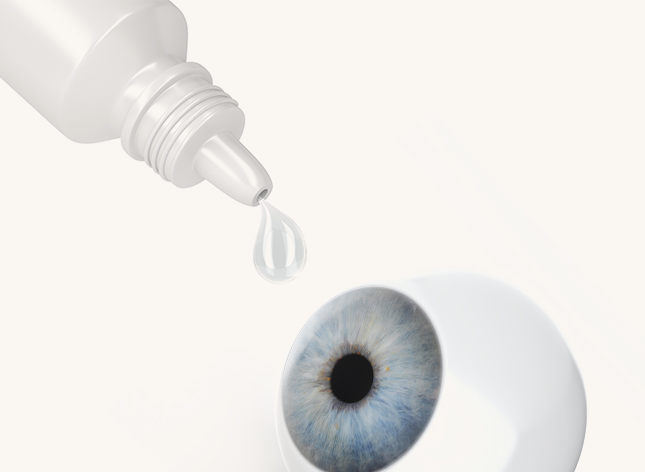
Studies such as the Hong Kong LAMP trial show low-dose atropine (for example 0.05%) can substantially slow myopia progression with few side effects. The dose is tailored to each child and monitored over time.
Q. Can we get a children’s myopia check in English near Guro?
Yes. Dr. Daniel Baik examines children in English or Korean at Nunehim Eye Center in Guro, a short trip from Gasan, Yeongdeungpo and Gwanak. Book via Naver for an after-school or Saturday-morning slot.

Book a Consultation
Worried about your child’s screen time or squinting? Book a children’s myopia check in Guro — convenient for families in Yeongdeungpo, Gasan and Gwanak.
📍 Visit Nunehim Eye Center — Guro, Seoul
Nunehim Eye Center is in Guro-gu, a short trip from Gasan Digital Complex, Yeongdeungpo, Gwanak and Dongjak. Near Guro Digital Complex Station (Line 2). English consultations available.
📌 Address
551 Siheung-daero, Guro-gu, Seoul
nunehim.com
🕘 Hours
Mon–Fri 09:00–18:30
(lunch 13:00–14:00)
Sat 09:00–14:00
🌐 Languages
Korean & English consultations
Related guides
About the author: Dr. Jinhag (Daniel) Baik, MD, is an ophthalmologist and the director of Nunehim Eye Clinic in Seoul, Korea (near Guro Digital Complex Station). A former Samsung semiconductor engineer, he welcomes English-speaking patients for vision correction, cataract, and general eye care.


Leave a comment