OCT Scan Explained: What This Eye Test Reveals
Advanced retinal imaging available in Yeongdeungpo, serving Guro, Gasan & Gwanak
Q. What is an OCT scan and what does it reveal about your eyes?
An OCT scan (Optical Coherence Tomography) is a non-invasive imaging test that uses light waves to capture detailed, cross-sectional images of the retina — the light-sensitive tissue at the back of the eye. An OCT scan eyes Seoul patients receive at Nunehim Eye Center can detect glaucoma, macular degeneration, diabetic retinopathy, retinal detachment, and many other conditions, often before any symptoms appear. The scan is painless, takes just minutes, and produces images with a resolution comparable to a microscopic biopsy — without any contact with the eye.
Q. How does OCT imaging work, and why is it so valuable?
OCT technology works similarly to ultrasound, but uses near-infrared light instead of sound waves. This allows the scanner to generate high-resolution, layered cross-sections of the retina and optic nerve in real time. At Nunehim Eye Center in Yeongdeungpo, our OCT system can measure the thickness of individual retinal layers to within a few micrometres — allowing Dr. Daniel Baik, board-certified ophthalmologist, to detect subtle structural changes that would be invisible on a standard fundus photograph. For patients in Guro, Gasan, and Gwanak, access to OCT imaging locally means earlier diagnosis and better outcomes for conditions that were once caught only at an advanced stage.
📊 Eye Health & OCT Screening in Korea
- ▸ Glaucoma affects approximately 3.4% of Koreans over 40 — and over 80% of cases in Korea are the “normal tension” subtype, which OCT is particularly effective at detecting early
- ▸ Korea has one of the highest rates of myopia in the world (nearly 97% in adolescents), increasing the risk of myopia-related retinal complications detectable by OCT
- ▸ Diabetic retinopathy is a leading cause of vision loss in Korea; OCT enables staging and treatment planning before vision deteriorates
- ▸ Annual OCT screening is now recommended for all patients over 40 and for myopic patients of any age by Korean ophthalmology guidelines
Q. What conditions can an OCT scan diagnose?
OCT scans are among the most versatile diagnostic tools in modern ophthalmology. At Nunehim Eye Center, they are routinely used to evaluate: glaucoma (measuring optic nerve fibre layer thickness), age-related macular degeneration (AMD), diabetic macular oedema, epiretinal membrane, macular hole, central serous retinopathy, and retinal vein occlusion. For patients planning TransPRK or 2-Day LASEK surgery, an OCT scan is part of the pre-operative assessment to ensure the retina is healthy before proceeding.
In children and young adults from Guro, Gasan, and Gwanak with high myopia, OCT also helps monitor for myopic maculopathy — a complication that can develop in eyes with more than -6 dioptres of short-sightedness. Early detection through regular OCT scanning is essential for preserving long-term vision in this population.
Q. What happens during an OCT scan appointment in Seoul?
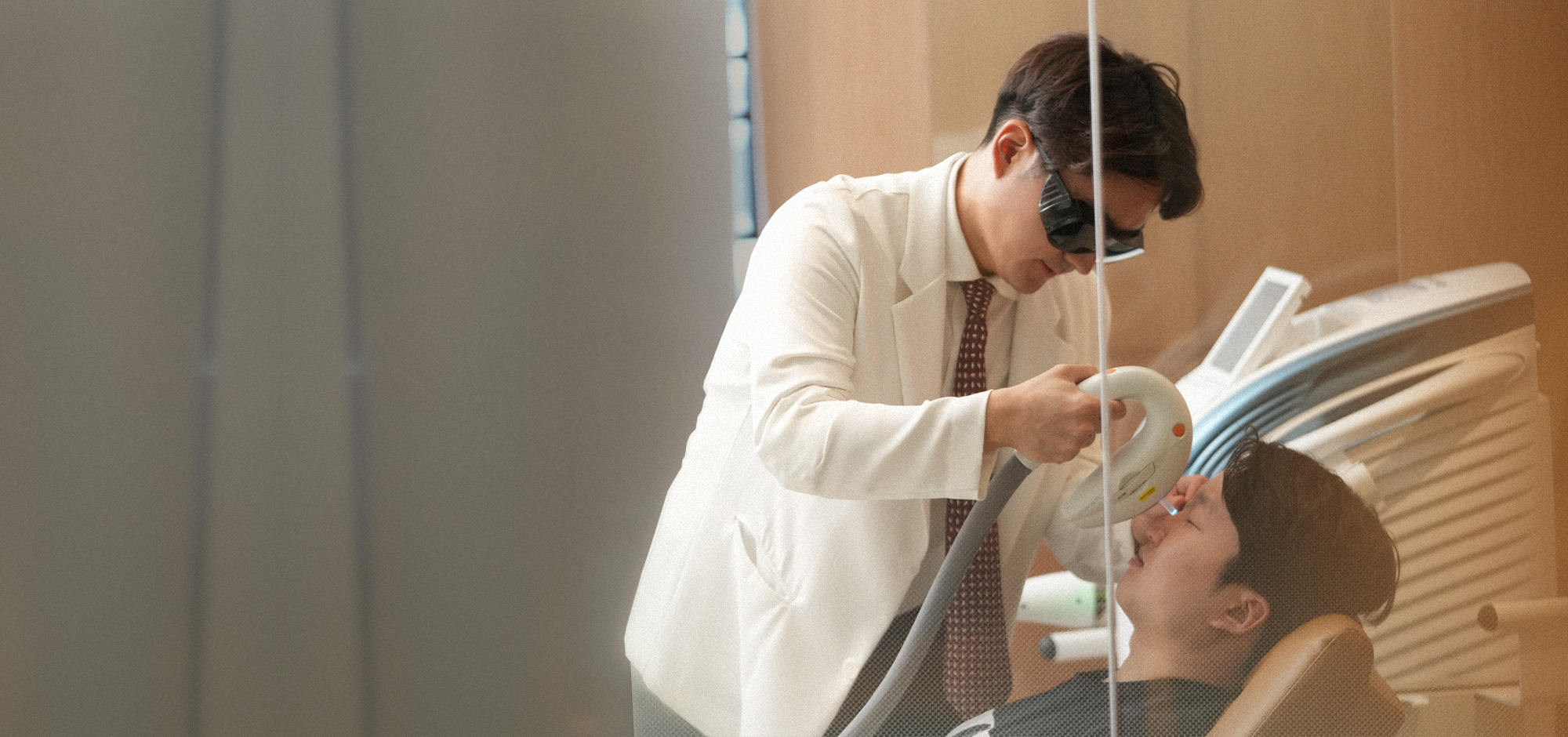
An OCT scan at Nunehim Eye Center is quick and entirely painless. No eye drops are required for a standard scan, though in some cases the pupil may be dilated to allow a wider view of the retina. You will be asked to rest your chin on a support and look at a small fixation target while the scanner captures images over 5–10 seconds. The entire appointment typically takes 15–30 minutes, including the consultation to review the results.
Dr. Daniel Baik, board-certified ophthalmologist, personally reviews all OCT images and explains findings in plain language — in both Korean and English. Patients from Yeongdeungpo, Guro, Gasan, and Gwanak frequently choose Nunehim Eye Center specifically because of the bilingual consultation service, which removes the language barrier often experienced at other clinics in Seoul.
Q. When should I get an OCT scan eyes Seoul check-up?
- You are over 40 years old — glaucoma screening is recommended annually
- You have high myopia (greater than -3 dioptres) — increased risk of retinal complications
- You have diabetes — diabetic retinopathy can be present without symptoms
- You have a family history of glaucoma, macular degeneration, or retinal disease
- You notice new floaters, flashes of light, or a shadow in your visual field
- You are being assessed for refractive surgery (TransPRK / 2-Day LASEK) at Nunehim Eye Center
🔬 Retinal OCT
Maps the 10 distinct layers of the retina. Detects AMD, diabetic changes, epiretinal membrane, and macular holes with micrometre precision.
🧠 Optic Nerve OCT
Measures the retinal nerve fibre layer (RNFL) around the optic disc. The primary tool for early glaucoma detection — can identify damage years before vision loss occurs.
💉 OCT-Angiography
Maps blood flow in the retinal vasculature without dye injection. Useful for evaluating diabetic retinopathy, AMD, and retinal vein occlusion at Nunehim Eye Center.
Dr. Daniel Baik, Board-Certified Ophthalmologist
“OCT imaging has transformed the way we practise ophthalmology. I can now show patients a detailed map of their retina and explain exactly what’s happening — in Korean or English — in a way that was simply not possible before. For our patients in Yeongdeungpo, Guro, Gasan, and Gwanak, having access to this level of diagnostic technology locally means we can catch glaucoma, macular disease, and myopic complications at the earliest possible stage, when treatment is most effective.”
❓ Frequently Asked Questions
Q. Is an OCT scan the same as a regular eye test?
No. A standard eye examination tests visual acuity and refraction (your prescription). An OCT scan goes much further: it images the internal structure of the eye in three dimensions, detecting diseases that have no symptoms in their early stages. Both are important — Nunehim Eye Center in Yeongdeungpo offers comprehensive examinations that include both.
Q. Does an OCT scan hurt?
Not at all. The OCT scanner never touches your eye. You simply look at a small target light while the machine scans. No anaesthetic or eye drops are required for a standard OCT, and there is no recovery time — you can drive and return to work immediately afterwards.
Q. How often should I have an OCT scan in Seoul?
For healthy adults over 40, annual OCT screening is recommended by Korean ophthalmology guidelines. Patients with glaucoma, high myopia, diabetes, or a family history of retinal disease may need scans every 6 months. Dr. Daniel Baik will advise on the appropriate interval based on your individual risk factors at your Nunehim Eye Center consultation.
Q. I have high myopia — do I need an OCT scan?
Yes, this is one of the most important indications for OCT in Korea, given the near-universal rates of myopia in Seoul. High myopia (over -6 dioptres) stretches and thins the retina, increasing the risk of retinal tears, detachment, and myopic maculopathy. Patients from Guro, Gasan, Gwanak, and Yeongdeungpo with high myopia should have annual OCT scans to monitor for these complications.
Q. Can OCT detect glaucoma before I notice any vision loss?
Yes — this is one of the most important clinical advantages of OCT. Glaucoma typically causes no symptoms until 30–40% of retinal nerve fibres have been permanently lost. OCT can detect thinning of the nerve fibre layer years before visual field defects appear on standard perimetry tests. Early detection means treatment can begin before irreversible damage occurs.
Q. Is an OCT scan covered by Korean health insurance (NHIS)?
OCT scanning for certain diagnoses — including glaucoma, diabetic retinopathy, and age-related macular degeneration — is covered by the National Health Insurance Service (NHIS) in Korea when medically indicated. Screening OCT for asymptomatic patients is typically a self-pay item. Nunehim Eye Center staff can advise on coverage during your booking.
Q. Can I get an OCT scan at Nunehim Eye Center with an English consultation?
Yes. Dr. Daniel Baik, board-certified ophthalmologist, conducts consultations in both Korean and English. Nunehim Eye Center in Yeongdeungpo is a popular choice for expats and international patients from across Seoul — including Guro, Gasan, and Gwanak — who want to understand their OCT results in detail in their preferred language.

Book Your OCT Scan at Nunehim Eye Center, Seoul
Serving Yeongdeungpo, Guro, Gasan & Gwanak. Korean & English consultations available.
📍 Visit Nunehim Eye Center — Yeongdeungpo, Seoul
Convenient access from Guro, Gasan, Gwanak & Dongjak. Near Guro Digital Complex Station (Line 2).
📍 Address
Yeongdeungpo-gu, Seoul
nunehim.com
🕐 Hours
Mon–Fri: 9am–6pm
Saturday: 9am–1pm
🌐 Languages
Korean & English consultations available


Leave a comment