Eye Floaters: Should You Worry? When to See a Doctor in Seoul
Expert guidance at Nunehim Eye Center — Yeongdeungpo · Guro · Gasan · Gwanak
Q. What are eye floaters and are they dangerous?
Eye floaters (비문증) are small drifting shapes — dots, threads, cobwebs — that appear to float in your field of vision. They are shadows cast by tiny clumps inside the vitreous gel that fills the eye. In Seoul, floaters are among the most common reasons patients visit an ophthalmologist. Most floaters are harmless and arise from natural age-related vitreous changes. However, a sudden increase in floaters — especially with flashes of light or a dark curtain across vision — can signal a retinal tear or detachment requiring urgent evaluation at an eye clinic in Yeongdeungpo, Guro, Gasan, or Gwanak.
Q. What exactly causes eye floaters?
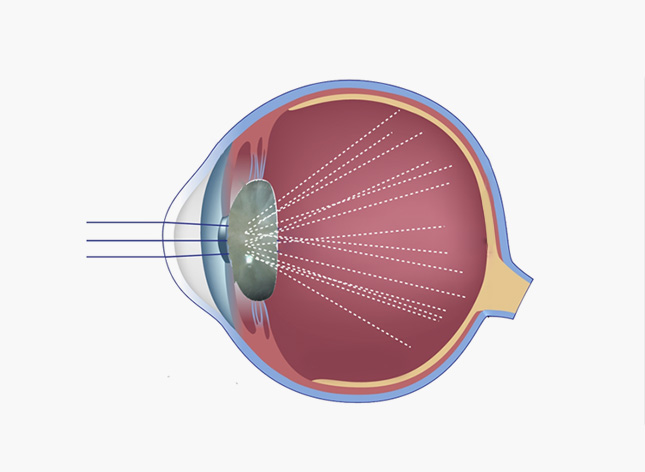
The vitreous humour is a clear jelly filling the eye, composed mainly of water, collagen fibrils, and hyaluronic acid. As we age, the vitreous slowly liquefies and shrinks, causing collagen fibres to clump and cast shadows on the retina — what we perceive as floaters. The most common cause of acute floaters is posterior vitreous detachment (PVD), typically affecting people over 50. In Korea, where myopia prevalence approaches 97% among young adults in cities like Seoul, floaters are increasingly common even in patients in their 20s and 30s. Highly myopic eyes have an elongated axial length, making the vitreous prone to early degeneration.
Q. What types of floaters should I be concerned about?
- PVD floaters (most common): Age-related, thread-like or cobweb-shaped. Typically benign.
- Myopia-related floaters: Common in highly myopic young adults in Guro, Gasan, Gwanak and Yeongdeungpo areas.
- Retinal tear floaters: Sudden shower of floaters with flashes — a medical emergency. Requires same-day evaluation.
- Vitreous haemorrhage: Sudden dense cloud or reddish haze from bleeding into the vitreous. Urgent care required.
- Uveitis-related floaters: Inflammatory cells in the vitreous, with redness and light sensitivity.
Eye Floaters in Korea — Key Facts
▸ Korea has near-100% myopia prevalence among urban young adults — making floaters common even under age 30
▸ Posterior vitreous detachment (PVD) occurs in ~75% of people over age 65, and much earlier in highly myopic patients
▸ Retinal detachment affects ~1 in 10,000 per year; high myopia increases this risk 10-fold
▸ Early treatment of retinal tears (within 24–48 hours) prevents detachment in over 95% of cases
▸ Floater consultations in Yeongdeungpo, Guro, and Gasan eye clinics have risen with both ageing and the myopia epidemic
Q. How can I tell if my floaters are harmless or a warning sign?
Benign floaters from PVD appear gradually as a few threads or dots, move with eye movement, and do not worsen significantly over days. Warning signs that require same-day evaluation at an eye clinic in Seoul — including our Yeongdeungpo and Guro locations — include: a sudden shower of new floaters; bright flashes of light (photopsia) in peripheral vision; a dark curtain or shadow spreading across your visual field; or sudden vision loss. These may indicate a retinal tear, detachment, vitreous haemorrhage, or acute uveitis.
Patients in Gasan and Gwanak with known high myopia are at particularly elevated risk and should seek evaluation promptly with any new sudden floaters.
Q. How are eye floaters treated at a Seoul eye clinic?
For most patients with benign PVD floaters, no treatment is needed — floaters often become less noticeable over 3–6 months as the brain adapts. If floaters significantly impair daily life or vision, two options exist:
YAG laser vitreolysis uses a focused laser to break up dense opacities in the vitreous, reducing their visual impact without surgery. Pars plana vitrectomy (PPV) surgically removes the vitreous gel (and floaters) and replaces it with saline — highly effective but carries surgical risks including cataract formation. Dr. Daniel Baik at Nunehim Eye Center in Yeongdeungpo evaluates patients from Guro, Gasan, and Gwanak individually to determine the most appropriate approach.

Q. When should I see an eye doctor urgently in Seoul for floaters?
- A sudden dramatic increase in floaters — especially a shower or cloud of new spots
- Flashing lights (photopsia) in peripheral vision
- A dark curtain, shadow, or veil spreading across any part of your visual field
- Any sudden loss of central or peripheral vision
- Floaters accompanied by pain or significant redness
- New floaters in the context of diabetic eye disease or recent eye trauma
- Floaters following recent cataract surgery or other ocular procedure
✅ Benign Floaters
A few stable threads or dots. Present for weeks to months. No flashes. Associated with age or mild myopia. Monitor with a follow-up dilated exam in 4–6 weeks.
⚠️ Monitor Closely
New floaters with occasional brief flashes. Known high myopia or prior eye surgery. Increasing number over days. Dilated retinal exam within 24–48 hours recommended.
🚨 See Doctor Today
Sudden shower of floaters. Persistent flashes. Dark curtain across vision. Reddish haze. Any vision loss. These require same-day evaluation — call Nunehim Eye Center now.
From Dr. Daniel Baik
“Floaters are one of the most anxiety-provoking symptoms I see at our Yeongdeungpo clinic — understandably so. The vast majority are benign posterior vitreous detachments, but the critical task is distinguishing these from the rare retinal tear that needs treatment within hours. My advice: if your floaters appeared suddenly or you are seeing flashes, please do not wait and watch at home. A dilated fundus exam takes under 20 minutes and can either give you complete peace of mind — or catch something that needs prompt intervention. We serve patients across Guro, Gasan, Gwanak, and the wider Seoul area.”
— Dr. Daniel Baik, Board-Certified Ophthalmologist, Nunehim Eye Center, Seoul

❓ Frequently Asked Questions About Eye Floaters in Seoul
Q. Do eye floaters go away on their own?
Many floaters from PVD become less noticeable over 3–6 months as the vitreous settles and the brain adapts. They rarely disappear completely. If floaters significantly impair your quality of life after several months, discuss YAG laser vitreolysis or other options with your ophthalmologist at our Yeongdeungpo or Guro clinic.
Q. Why are floaters more visible against a bright sky or white wall?
Floaters are shadows cast by vitreous opacities onto the retina. Against a uniform bright background — blue sky, white wall, or bright screen — these shadows become far more visible. In complex or dim environments the brain more easily filters them out. This is completely normal and not a sign that your floaters are worsening.
Q. I am highly myopic — am I at greater risk for serious floaters?
Yes. High myopia (typically -6 dioptres or more) significantly increases the risk of retinal tears, detachment, and early vitreous degeneration. In Seoul — where near-100% myopia is seen among school-leavers in Gasan, Gwanak, and Guro — this is a major public health issue. Dr. Daniel Baik recommends that highly myopic patients have an annual dilated fundus exam and present promptly for any new or sudden floaters.
Q. What is a retinal detachment and how is it treated?
A retinal detachment occurs when the retina separates from the back wall of the eye, cutting off its blood supply. Without treatment, permanent vision loss follows. Treatment is surgical — pneumatic retinopexy, scleral buckling, or vitrectomy, depending on the type and location. Outcomes are significantly better when surgery is performed within 24–48 hours. A sudden curtain-like visual field loss is an ocular emergency requiring immediate attention.
Q. Can stress or dehydration cause eye floaters?
Stress and dehydration do not directly cause floaters. However, fatigue and stress can make you more aware of pre-existing ones. Floaters are a structural phenomenon in the vitreous — they are not created by emotional state. If you suddenly notice floaters you have always had, this is a shift in attention rather than a change in the vitreous itself. A dilated eye exam will clarify the situation.
Q. Do you offer English consultations for eye floaters at your Seoul clinic?
Yes. Dr. Daniel Baik consults in both Korean and English, making Nunehim Eye Center accessible to expats across Seoul. Patients from Yeongdeungpo, Guro, Gasan, and Gwanak are welcome. If you have new floaters and are concerned, visit nunehim.com to learn more or arrange an appointment.
Q. Can children develop eye floaters?
Yes, though less commonly than adults. Floaters in children should be evaluated promptly to rule out uveitis or other intraocular conditions. Given the very early onset of myopia in Korean children — particularly in school-dense areas like Gwanak and Gasan — myopia-related vitreous changes are being seen at increasingly young ages. Any child reporting floating spots should be seen by an ophthalmologist experienced in paediatric eye care.

Concerned About Eye Floaters? See a Specialist in Seoul
Retinal and floater evaluation at Nunehim Eye Center — Yeongdeungpo · Guro · Gasan · Gwanak
📍 Visit Nunehim Eye Center — Guro, Seoul
Convenient access from Guro, Gasan, Gwanak & Dongjak. Near Guro Digital Complex Station (Line 2).
📌 Address
Guro-gu, Seoul | nunehim.com
🕐 Hours
Mon–Fri: 9:00–18:00 | Sat: 9:00–13:00
🌐 Languages
Korean & English consultations available


Leave a comment