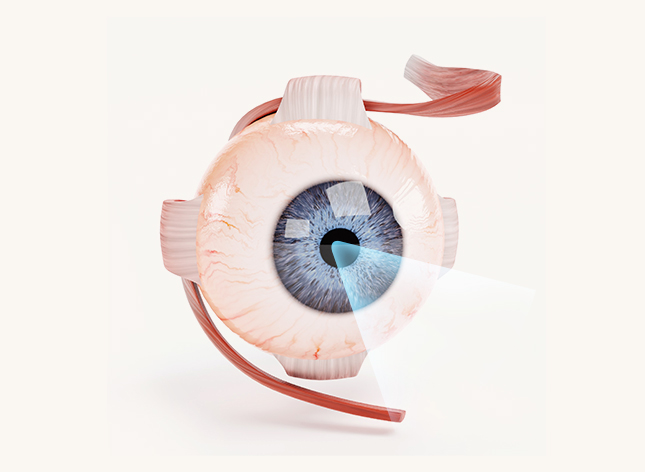
Why Children in Korea Have High Myopia Rates — And What to Do
A board-certified ophthalmologist explains prevention and treatment for Seoul families
Q. Why is childhood myopia Korea so common?
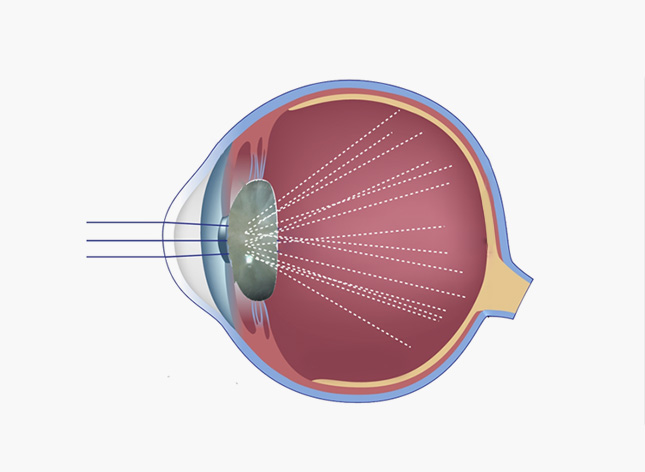
Children in Korea develop myopia at some of the highest rates in the world, driven by intensive near-work study schedules, limited outdoor time, and genetic predisposition. Large-scale studies of Korean teenagers have recorded myopia rates approaching 80–96%, and early detection paired with treatments such as low-dose atropine drops, orthokeratology (OK lenses), and more outdoor time can meaningfully slow its progression.
Q. What is causing high myopia rates in Korean children?
Korea’s academic culture places enormous demands on young eyes. Long hours of close-up study at school and at after-school hagwon, combined with smartphone and tablet use, mean many children spend well over ten hours a day focusing at near distances. This sustained near-work is one of the strongest known risk factors for myopia onset and progression. Add to this Korea’s dense urban environment — where children in neighborhoods like Yeongdeungpo, Guro, and Gasan often have limited access to open outdoor space compared to children in more rural regions — and the result is a population uniquely susceptible to early and progressive nearsightedness. Genetics also play a role: children with one or both myopic parents face a substantially higher risk, but environment appears to be the dominant driver of Korea’s exceptionally high rates.
Myopia in Korea — Key Statistics
- ▸ A landmark Seoul conscription study (Jung et al., Ophthalmology 2012) found myopia in roughly 96.5% of 19-year-old men examined in Seoul.
- ▸ High myopia (worse than -6.00D) affects an estimated one in five young adults in Korea, well above global averages.
- ▸ Myopia onset before age 8 substantially raises a child’s lifetime risk of progressing to high myopia and related complications.
- ▸ Regional studies suggest that 40 minutes to 2 hours of additional outdoor time daily can meaningfully reduce the risk of myopia onset in children.
Q. What are the treatment and management options for children in Korea?
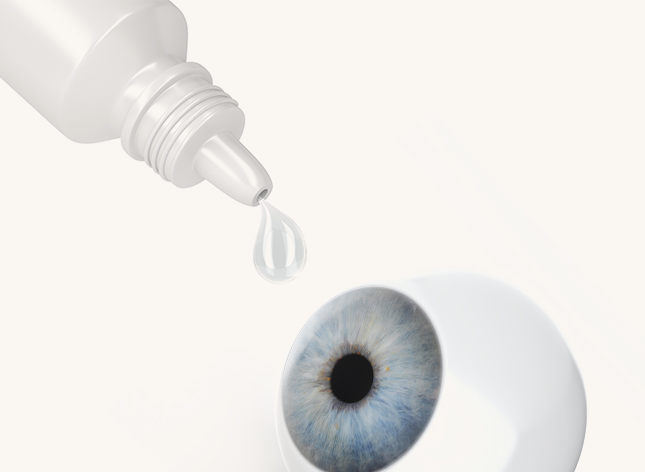
Modern myopia control goes beyond simply prescribing stronger glasses each year. Low-dose atropine eye drops (typically 0.01%–0.05%), used nightly under an ophthalmologist’s supervision, have been shown in Asian studies to slow the rate of progression. Orthokeratology (OK lenses) — rigid lenses worn overnight to temporarily reshape the cornea — can also correct vision during the day while slowing axial elongation, and are a popular option among families in Yeongdeungpo and Guro seeking to avoid daytime glasses or contacts.
Specially designed myopia-control soft contact lenses and spectacle lenses with peripheral defocus technology are newer additions to the toolkit. The right approach depends on the child’s age, prescription, lifestyle, and how quickly their myopia is progressing — which is why regular monitoring, including axial length measurement, matters as much as the treatment chosen.
Q. When should parents in Yeongdeungpo, Guro, or Gasan see a doctor?
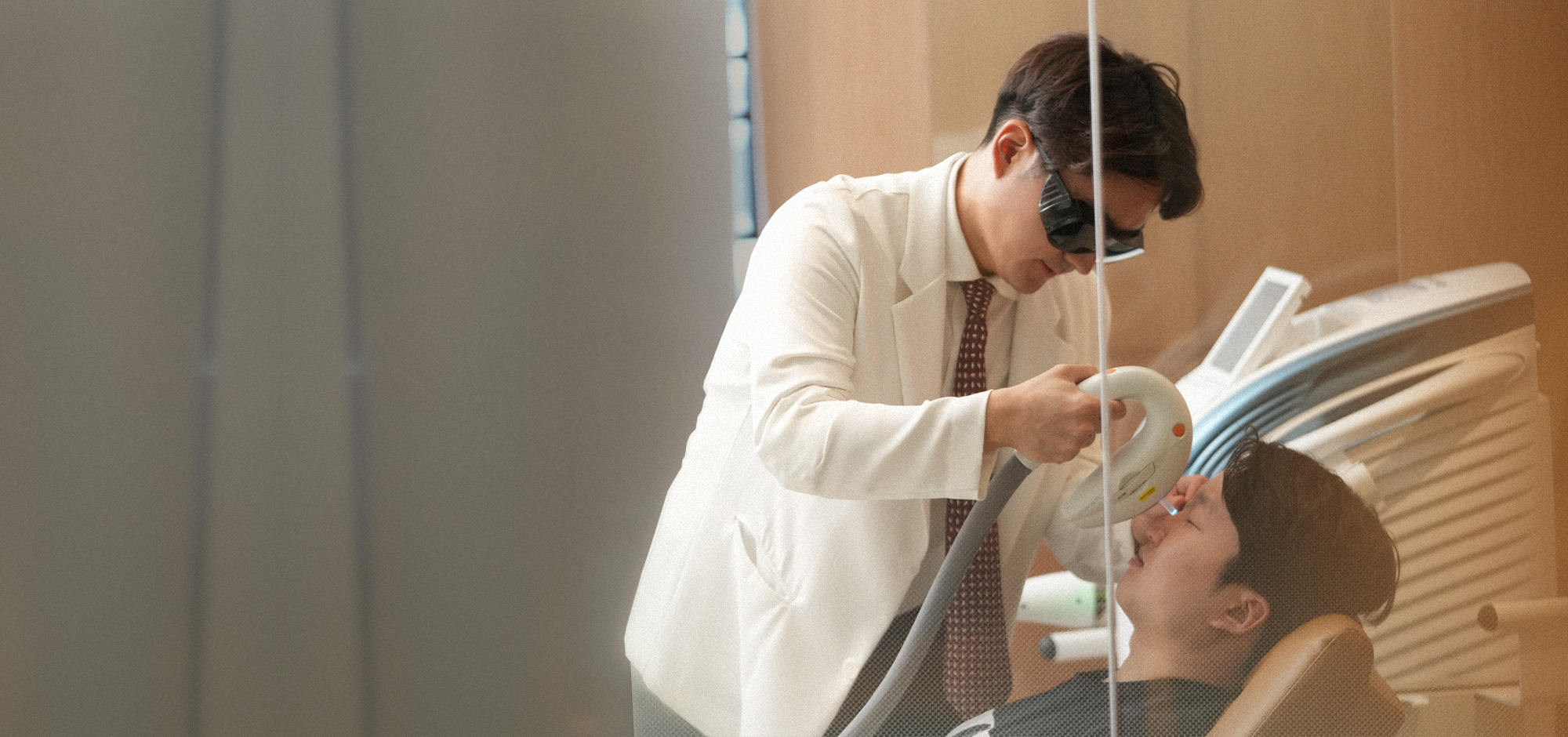
We recommend a first comprehensive eye exam around age 3, with annual checks afterward — sooner if a child squints, sits close to screens, complains of headaches, or has myopic parents. Families across Yeongdeungpo, Guro, Gasan, and Gwanak bring children to Nunehim Eye Center for baseline exams and ongoing myopia monitoring, since early intervention gives the widest range of treatment options and the best chance of slowing progression before it becomes severe.
Q. What warning signs should parents never ignore?
- Frequent squinting or sitting very close to the TV or tablet
- Headaches or eye strain after reading or homework
- Holding books or phones unusually close to the face
- One eye drifting outward or inward
- A rapid jump in glasses prescription from one year to the next
Mild Myopia
−0.25 to −3.00D. Often manageable with glasses alone and close monitoring.
Moderate to High
−3.25D and beyond. Warrants active myopia-control treatment to slow progression.
Exam Timeline
First exam at age 3, then annually — more often if prescription is changing quickly.
From Dr. Daniel Baik
“In my practice at Nunehim Eye Center, I see the effects of Korea’s intense study culture every day — children as young as six presenting with early myopia. The earlier we start monitoring axial length and discussing outdoor time and myopia-control options with families, the more we can do to protect a child’s long-term eye health.” — Dr. Daniel Baik, board-certified ophthalmologist
❓ Frequently Asked Questions
Q. At what age should my child have their first eye exam?
We recommend a baseline exam around age 3, or earlier if you notice squinting, eye misalignment, or a family history of high myopia. After that, annual exams are ideal so any change in prescription is caught early.
Q. Can myopia in children be reversed?
No — once the eye has elongated, that change is not reversible. But progression can be slowed significantly with the right combination of atropine drops, myopia-control lenses, and outdoor time, which is why early treatment matters so much.
Q. What is atropine eye drop therapy, and is it available in Korea?
Low-dose atropine (typically 0.01%–0.05%), used nightly, is one of the best-studied myopia control treatments in Asia. It is available and commonly prescribed at ophthalmology clinics in Korea, including Nunehim Eye Center, with regular follow-up to monitor response.
Q. Can OK lenses (orthokeratology) slow my child’s myopia progression?
Yes. Overnight orthokeratology lenses temporarily reshape the cornea to correct vision during the day, and studies suggest they can also slow axial elongation compared to glasses alone. They require careful fitting and hygiene, so we assess each child individually before recommending them.
Q. How much outdoor time actually helps prevent myopia?
Research from East Asia suggests roughly 2 hours of outdoor time daily is associated with a meaningfully lower risk of myopia onset, likely due to bright light exposure and reduced near-work during that time — even 40 extra minutes a day has shown measurable benefit in some studies.
Q. Is high myopia dangerous for my child’s future eye health?
High myopia increases the lifetime risk of retinal detachment, myopic macular degeneration, glaucoma, and earlier cataracts. This is precisely why slowing progression in childhood — rather than just correcting vision — is the goal of modern myopia management.
Q. Does Nunehim Eye Center see children from Yeongdeungpo, Guro, and Gasan?
Yes. We regularly see pediatric patients from Yeongdeungpo, Guro, Gasan, and Gwanak for routine exams, myopia monitoring, and treatment, with consultations available in both Korean and English.

Book a Consultation
Nunehim Eye Center — nunehim.com
📍 Visit Nunehim Eye Center — Guro, Seoul
Convenient access from Guro, Gasan, Gwanak & Dongjak. Near Guro Digital Complex Station (Line 2).
Address: 551 Siheung-daero, Guro-gu, Seoul / nunehim.com
Hours: Mon–Fri 09:00–18:30 (lunch 13:00–14:00), Sat 09:00–14:00
Languages: Korean & English


Leave a comment