Presbyopia Surgery in Seoul: Multifocal IOL, LASEK or Reading Glasses?
A board-certified ophthalmologist’s guide for patients in Yeongdeungpo, Guro, Gasan, and Gwanak
Quick Answer
Presbyopia surgery in Seoul generally means selecting among three paths: multifocal or trifocal intraocular lens (IOL) exchange, monovision LASEK (2-Day LASEK), or continuing with progressive reading glasses. The best choice depends on your age, current refractive error, pupil size, and how you use your eyes day to day, and should always be confirmed with a full eye exam at a Seoul clinic before deciding.
Q. What is presbyopia surgery in Seoul?
Presbyopia surgery Seoul options are procedures designed to reduce dependence on reading glasses once the eye’s natural lens loses its ability to focus up close, a change that affects nearly everyone after age 40. In Korea, this typically means either replacing the eye’s lens with a multifocal or trifocal IOL, reshaping the cornea with monovision LASEK, or in some cases placing a small corneal inlay. Patients across Yeongdeungpo, Guro, Gasan, and Gwanak increasingly ask about these options as they look for alternatives to progressive glasses or reading glasses left on every desk and nightstand.
Q. What are the signs I may need presbyopia correction?
- Holding books, menus, or phones at arm’s length to bring text into focus
- Needing brighter light to read comfortably
- Eye strain or headaches after close work, especially in the evening
- Blurred near vision that improves temporarily when you squint
Presbyopia by the Numbers
▸ Nearly 100% of adults develop some degree of presbyopia by their mid-to-late 40s
▸ Presbyopia consultations are among the fastest-growing reasons for eye clinic visits as Korea’s population ages
▸ Many Seoul patients also carry moderate myopia, which complicates simple reading-glasses-only solutions
▸ Multifocal IOL adoption in Korea has risen sharply over the past decade as lens technology has improved
Q. What are my treatment options for presbyopia in Seoul?
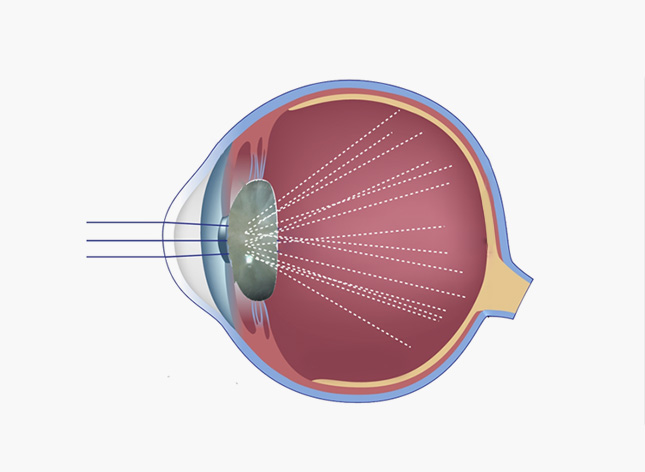
Multifocal or trifocal IOL exchange replaces the eye’s natural lens with an artificial lens that provides distance, intermediate, and near focus simultaneously, often performed alongside cataract surgery for patients over 50. Monovision LASEK (2-Day LASEK) instead corrects one eye for distance and the other slightly for near vision, using the same TransPRK/2-Day LASEK technology used for standard vision correction, without implanting anything inside the eye.
For patients not ready for surgery, updated reading glasses or progressive lenses remain a safe, reversible starting point. Many patients in Guro and Yeongdeungpo begin with glasses and revisit surgical options a few years later once their prescription has stabilized.
Q. Who is a good candidate for presbyopia surgery?
Good candidates are generally over 45, in good general eye health, and free of significant cataract, glaucoma, or retinal disease — though patients who already need cataract surgery are often excellent candidates for combined multifocal IOL correction. Candidates for monovision LASEK should have healthy corneal thickness and be comfortable adapting to a slight difference between their two eyes.
Patients from Gasan and Gwanak who work long hours at a screen often ask specifically about intermediate-distance clarity, since reading-only correction does not always address computer-distance vision — an important point to raise during your consultation.
Q. What are the risks and limitations to know?
- Multifocal IOLs can cause glare or halos around lights at night, especially in the first few months
- Monovision LASEK requires an adaptation period, and not everyone tolerates the vision difference between eyes
- No presbyopia procedure permanently stops the eye’s natural aging process — some reading glasses use may still be needed for fine print
- Combined procedures (e.g., cataract plus multifocal IOL) carry the standard risks of intraocular surgery and should be discussed in detail beforehand
Early Presbyopia (40s)
Mild difficulty with fine print; reading glasses or monovision LASEK are usually sufficient.
Progressive Presbyopia (45–55)
Near vision continues to decline; multifocal IOL becomes a stronger long-term option.
Stable Presbyopia (55+)
Often overlaps with early cataract changes, making combined cataract and multifocal IOL surgery a common path.
“As a board-certified ophthalmologist, I always start with a detailed refraction and corneal exam before recommending multifocal IOL or LASEK for presbyopia. Patients from Yeongdeungpo, Guro, Gasan, and Gwanak come to us wanting a straightforward answer, and the right one is different for every patient — which is why an individualized consultation matters more than any single procedure.”
— Dr. Daniel Baik, Nunehim Eye Center
❓ Frequently Asked Questions
Q. What age does presbyopia surgery become an option?
Most patients consider presbyopia surgery from their mid-40s onward, once near vision has noticeably declined and stabilized enough for accurate measurement. Some patients wait until their late 50s when it can be combined with cataract surgery.
Q. Is multifocal IOL surgery painful?
The procedure itself is performed under topical or light local anesthesia and is not typically described as painful. Mild irritation or light sensitivity for a day or two afterward is common.
Q. How long is recovery after LASEK for presbyopia?
2-Day LASEK typically involves noticeable discomfort for the first one to two days, with functional vision returning within about a week, though full stabilization can take several weeks.
Q. Can I combine cataract surgery with presbyopia correction?
Yes — this is one of the most common approaches in patients over 55, since replacing a cataract-affected lens with a multifocal IOL addresses both conditions in a single procedure.
Q. Will I still need reading glasses after surgery?
Many patients significantly reduce their dependence on reading glasses, but some still keep a pair for very fine print or dim lighting. Complete independence from glasses cannot be guaranteed for every patient.
Q. How much does presbyopia surgery cost in Seoul?
Cost varies by procedure, lens technology, and whether cataract surgery is combined, so an individual quote is provided after your consultation and exam at the clinic.
Q. Is monovision LASEK reversible?
Monovision LASEK reshapes the cornea and is not designed to be reversed, though residual prescription can sometimes be fine-tuned with an enhancement. Patients uncertain about tolerating monovision can trial the effect with contact lenses first.

Book a Consultation
Nunehim Eye Center — nunehim.com — Korean & English consultations available
📍 Visit Nunehim Eye Center — Guro, Seoul
Convenient access from Guro, Gasan, Gwanak & Dongjak. Near Guro Digital Complex Station (Line 2).
Address: 551 Siheung-daero, Guro-gu, Seoul / nunehim.com
Hours: Mon–Fri 09:00–18:30 (lunch 13–14), Sat 09:00–14:00
Languages: Korean & English


Leave a comment