Ptosis (Droopy Eyelid): Causes & Treatment Options in Seoul
Diagnosis and treatment for droopy eyelids — Yeongdeungpo, Guro, Gasan & Gwanak, Seoul
Quick Answer
Ptosis (droopy eyelid) treatment in Seoul depends on cause and severity — ranging from observation for mild, stable cases to surgical eyelid lift (levator or Müller’s muscle resection) when the droop blocks vision or affects appearance. An eye exam determines the right approach.
Q. What is ptosis (droopy eyelid)?
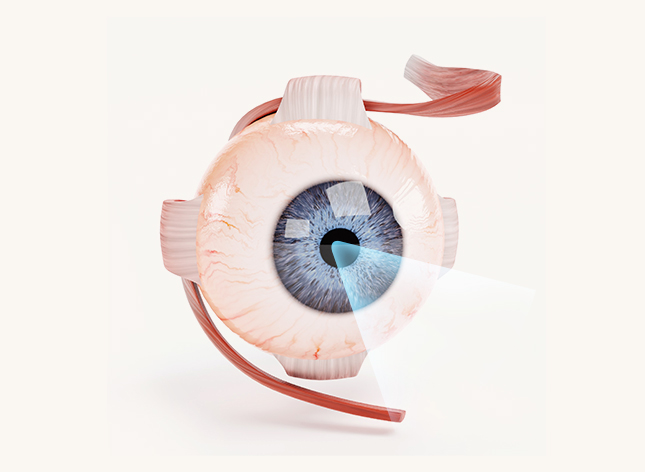
Ptosis is an abnormally low position of the upper eyelid margin, which can partially or fully cover the pupil. It may be present from birth (congenital ptosis) or develop later in life (acquired ptosis) due to aging, muscle weakness, nerve problems, prior eye surgery, or years of contact lens wear. Ptosis is different from simple loose or excess eyelid skin, though the two are often confused.
Q. What causes ptosis?
- Involutional (age-related) stretching of the levator muscle tendon — the most common cause in adults
- Congenital underdevelopment of the levator muscle, present from birth
- Long-term rigid or circle contact lens wear, from repeated mechanical traction on the eyelid
- Neurological causes such as myasthenia gravis or third cranial nerve palsy
- Eyelid trauma, prior eye surgery, or a mass pressing on the eyelid
Ptosis in Korea — Key Statistics
- ▸ Involutional ptosis is the most common type seen in adults over 50 in Korea
- ▸ Long-term circle lens and rigid lens wear is an increasingly common cause among younger patients in Seoul
- ▸ Congenital ptosis affects a small but consistent share of newborns each year
- ▸ Untreated significant ptosis in children can cause amblyopia (lazy eye)
Q. How is ptosis treated?
Mild, stable ptosis that does not affect vision may simply be monitored. When the droop is more significant, surgical eyelid lift is the primary treatment — typically levator resection or Müller’s muscle resection performed under local anesthesia. Severe congenital ptosis with very weak muscle function may require a frontalis sling procedure that uses the forehead muscle to help lift the eyelid.
At Nunehim Eye Center, every ptosis evaluation includes measurement of eyelid height, levator function, and visual field testing so patients across Yeongdeungpo, Guro, and Gasan receive a plan matched to the actual cause.
Q. When does ptosis require surgery?
Surgery is generally recommended when the eyelid measurably blocks part of the pupil or visual field, when the droop is progressively worsening, or when it is causing significant asymmetry or eye strain from compensating with raised eyebrows or a tilted head. In children, any ptosis that risks blocking visual development is treated more urgently.
⚠️ When to seek prompt evaluation
- Sudden-onset ptosis, especially with double vision, eye pain, or a dilated pupil — seek emergency care
- Ptosis in an infant or young child that appears to block the line of sight
- Rapidly worsening droop over days to weeks
- Ptosis accompanied by muscle weakness elsewhere in the body
Mild
Slight droop, vision unaffected. Often just monitored.
Moderate
Partial pupil coverage; surgical lift usually recommended.
Severe
Significant visual obstruction; may need frontalis sling, especially in children.
From Dr. Daniel Baik
“Many patients in Guro and Gwanak wait years assuming droopy eyelids are just cosmetic. As a board-certified ophthalmologist, I always check whether the droop is affecting the visual field first — that finding changes both the urgency and the treatment plan.”
❓ Frequently Asked Questions
Q. Is droopy eyelid surgery painful?
Ptosis surgery is performed under local anesthesia and most patients describe pressure rather than sharp pain. Mild soreness and swelling for a few days afterward is normal and managed with cold compresses and standard pain relief.
Q. How long is recovery after ptosis surgery?
Initial swelling and bruising typically resolve within 1 to 2 weeks, and most patients in our Seoul clinic return to work or school within a week. Final eyelid position and symmetry continue to settle over 1 to 3 months.
Q. Will insurance cover ptosis surgery in Korea?
National Health Insurance may cover ptosis repair when the droop measurably obstructs the visual field, based on documented exam findings. Purely cosmetic eyelid procedures are generally not covered. We review eligibility during your consultation.
Q. Can ptosis come back after surgery?
Recurrence is uncommon but possible, particularly with involutional ptosis as the eyelid muscle and skin continue to age, or if the underlying cause (such as long-term contact lens wear) continues. Regular follow-up helps catch any change early.
Q. Is ptosis the same as excess eyelid skin (dermatochalasis)?
No. Dermatochalasis is excess or sagging eyelid skin, while ptosis is the eyelid margin itself sitting lower due to weakness of the levator muscle. The two can occur together, and an exam is needed to tell them apart since treatment differs.
Q. Can children develop ptosis?
Yes. Congenital ptosis is present from birth and, if it blocks the visual axis, can cause amblyopia. Pediatric ptosis is evaluated more urgently than adult-onset ptosis because a child’s visual development is time-sensitive.
Q. Does long-term circle lens or rigid contact lens wear really cause ptosis?
Yes — repeated mechanical tugging on the eyelid during lens insertion and removal over many years is a well-recognized cause of acquired ptosis, and we see this pattern regularly in younger patients across Yeongdeungpo and Guro.

Book a Consultation
Get an eyelid and vision assessment for ptosis at Nunehim Eye Center, Seoul.
nunehim.com
📍 Visit Nunehim Eye Center — Guro, Seoul
Convenient access from Guro, Gasan, Gwanak & Dongjak. Near Guro Digital Complex Station (Line 2).
Address
551 Siheung-daero, Guro-gu, Seoul
nunehim.com
Hours
Mon–Fri 09:00–18:30 (lunch 13–14)
Sat 09:00–14:00
Languages
Korean & English


Leave a comment