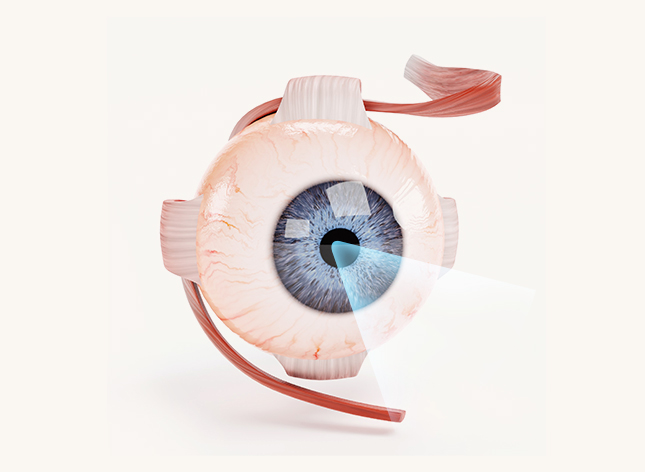
Dry Eye Not Improving with Artificial Tears? The Real Cause May Be Your Meibomian Glands
FDA-cleared M22 IPL dry eye treatment, explained — Dr. Daniel Baik, Nunehim Eye Center, Guro-gu, Seoul
Quick Answer
If dry eye keeps coming back minutes after using artificial tears, the underlying problem is often Meibomian Gland Dysfunction (MGD) — a blocked-oil-gland condition that causes tears to evaporate too fast, not too little tear volume. M22 IPL is an FDA-cleared light therapy for MGD-related evaporative dry eye that helps restore gland function when artificial tears alone aren’t enough, and it is billed as a non-covered (비급여) procedure that may or may not be reimbursable under private supplemental insurance depending on your policy.
Q. Why does dry eye persist even when tears are present?
Tears aren’t just water. The tear film is a layered structure that stabilizes and protects the eye’s surface, and its outermost lipid (oil) layer keeps tears from evaporating too quickly. That oil comes from the Meibomian glands inside the eyelids. When the gland openings become blocked or the oil becomes too thick to flow normally, the oil layer becomes unstable and tears evaporate rapidly — even if tear volume itself is normal. This is classic Meibomian Gland Dysfunction (MGD)-related evaporative dry eye, and it explains why patients in Gasan and Guro Digital Complex who use artificial tears all day still feel dry by afternoon.
Q. What are the signs your dry eye may be caused by MGD?
- Artificial tears provide relief for only a few minutes before dryness returns
- Eyes feel stinging or sandy as the afternoon goes on
- Burning sensation after long periods on a computer or phone
- Oily debris or buildup along the eyelid margins
- Recurring styes (chalazion/hordeolum)
- Dryness that’s worse in the evening than in the morning
- Vision that clears briefly with a blink, then blurs again
These symptoms alone don’t confirm MGD — a proper diagnosis also requires checking tear film breakup time, the corneal and conjunctival surface, eyelid inflammation, and the meibomian glands themselves.
Q. Are artificial tears a bad treatment?
Not at all — artificial tears remain a core foundation of dry eye treatment. They replace missing moisture, reduce surface friction, and protect the cornea and conjunctiva. But when the root problem is the meibomian glands, simply adding more water doesn’t fix an unstable oil layer, which is why relief can feel short-lived. The more useful question isn’t “how many times am I using drops,” but “why is my tear film unstable in the first place?”
Q. What is M22 IPL?
IPL stands for Intense Pulsed Light. It’s often searched as “dry eye laser treatment,” but technically it is not a single-wavelength laser — it delivers broad-spectrum pulses of light across multiple wavelengths. The M22 is Lumenis’ IPL platform, and the U.S. FDA granted De Novo clearance to the Lumenis OptiLight (Stellar M22) specifically as an IPL device for managing dry eye disease due to Meibomian Gland Dysfunction in 2021.
This means M22 IPL is not used for every kind of dry eye — it is specifically considered for evaporative dry eye linked to MGD.
Q. How does M22 IPL help with dry eye?
Research points to a few mechanisms working together, rather than just one: (1) it helps liquefy thickened meibum so blocked gland openings can be expressed and cleared; (2) it may improve the chronic inflammatory environment around the eyelid margin that accompanies MGD; and (3) as glands release more normal oil, the tear film’s lipid layer stabilizes, which is why some patients show measurable improvement in tear breakup time (TBUT) after treatment.
In short: it isn’t a treatment that makes more tears — it’s a treatment that helps the tears you already have stay on the eye’s surface longer.
Q. What does the research show?
Multiple randomized trials and systematic reviews have reported that IPL treatment in patients with MGD-related dry eye can improve dry eye symptoms, tear film stability, and meibomian gland function markers — particularly when IPL is combined with meibomian gland expression. That said, IPL is not a one-time cure: dry eye is a chronic condition influenced by tear production, eyelid inflammation, environment, contact lens wear, medications, and lifestyle, so results and how long they last vary by patient.
Q. How does Nunehim Eye Center evaluate dry eye before recommending IPL?
- Slit-lamp exam — checks the cornea, conjunctiva, and eyelid margin for inflammation
- Tear film breakup time (TBUT) — measures how stable the tear film is on the eye’s surface
- Meibomian gland assessment — evaluates blockage at the gland openings and the quality of the oil
- Meibography when needed — images structural loss or changes in the glands themselves
The goal is always to classify what’s actually going on — aqueous-deficient, evaporative/MGD-related, or a mixed picture — before deciding on IPL rather than starting with it.
Step 1: Warm Compress
Softens thickened meibum around the eyelids before treatment.
Step 2: M22 IPL
Light pulses applied to protected facial skin around the eyes.
Step 3: Gland Expression
Slit-lamp guided expression clears loosened meibum from the glands.
The exact combination and number of sessions is adjusted to each patient’s MGD severity and ocular surface condition rather than a fixed one-size-fits-all protocol.
Artificial Tears vs. Warm Compress vs. IPL + MGD Management
| Artificial Tears | Warm Compress | IPL + MGD Management | |
|---|---|---|---|
| Main goal | Lubricate the surface, replace moisture | Soften meibum to aid natural drainage | Improve symptoms and gland environment in MGD-related dry eye |
| Strengths | Simple, easy to use | Can be done at home | Addresses the MGD cause more directly |
| Limitations | May not resolve MGD itself | Effect varies with temperature/duration | Not suitable for every dry eye patient |
| Best suited for | Baseline care for most dry eye | Mild MGD, as a supportive measure | Confirmed MGD not adequately controlled by basics alone |
| Can combine with others? | Yes | Yes | Often combined with the other two |
No single option is automatically “better” — the right combination depends on which problem is dominant in your particular case.
Q. How many M22 IPL sessions are needed?
The number and spacing of sessions depends on dry eye severity, meibomian gland condition, skin type, and the specific device/protocol used. Clinically, a series of sessions at set intervals is common. Rather than promising a fixed number upfront, we plan and adjust based on your test results and how you respond to treatment.
Q. Are there side effects?
No medical procedure carries zero risk. Some patients experience temporary skin redness, warmth, stinging, irritation, or pigment changes after IPL. Eye injury is a rare but serious risk if proper eye protection isn’t used, which is why ophthalmologist oversight and correct protective equipment matter. Skin type, photosensitivity conditions, and certain medications can also make a patient unsuitable for IPL, so a pre-treatment consultation is required.
Q. Is M22 IPL actually FDA-cleared?
Yes, with an important nuance: in 2021 the U.S. FDA granted De Novo clearance to the Lumenis M22-based OptiLight IPL device specifically for improving the signs of dry eye disease due to Meibomian Gland Dysfunction, under defined patient criteria and usage parameters. It is not accurate to say “FDA-approved for all dry eye” — the more precise description is “an FDA-cleared IPL device for managing dry eye caused by MGD.”
Q. Can I claim M22 IPL through private insurance (실손보험) in Korea?
M22 IPL for dry eye is typically billed as a non-covered (비급여) procedure. Whether your private supplemental insurance actually reimburses it depends on when you purchased your policy, the specific plan terms, the diagnosis and treatment purpose, and your insurer’s own review — the clinic cannot guarantee reimbursement. We recommend checking with your insurer beforehand whether non-covered IPL treatment for dry eye or MGD is a covered benefit under your plan. We’re happy to issue receipts and itemized statements for insurance claims on request.
From Dr. Daniel Baik
“What matters in dry eye treatment isn’t which treatment is most talked about — it’s finding what’s actually causing your specific dry eye. If you keep reaching for artificial tears all day and still feel dry, stinging, or hard to keep your eyes open by afternoon, it’s worth having your meibomian glands and tear film checked properly.”
❓ Frequently Asked Questions
Q. If artificial tears aren’t helping, should I get IPL right away?
Not necessarily. The first step is identifying what’s actually causing your dry eye. If testing confirms MGD as the main driver and symptoms aren’t adequately controlled with artificial tears and warm compresses alone, IPL becomes one of the treatment options to consider — not an automatic next step.
Q. Do I need to stop using artificial tears during IPL treatment?
No. Artificial tears or prescription drops can continue alongside IPL treatment based on your individual condition, since dry eye often has more than one contributing cause at once.
Q. Does IPL cure dry eye completely?
IPL is not a guaranteed cure. It aims to improve MGD-related symptoms and tear film stability, but symptoms can recur depending on your environment, habits, and meibomian gland condition over time.
Q. Does the IPL light go directly into the eye?
Under standard FDA-cleared protocols, the eyes are protected and the light is applied to the facial skin around the eyes, not directly into them. Exact technique can vary by device and provider protocol.
Q. Is IPL technically a laser?
Not exactly. A laser uses a single wavelength of light, while IPL (Intense Pulsed Light) uses multiple wavelengths in broad-spectrum pulses. It’s often loosely called ‘dry eye laser treatment’ in casual search terms, but the technology is different.
Q. Does M22 IPL work for all types of dry eye?
No. It’s primarily considered for evaporative dry eye caused by Meibomian Gland Dysfunction. If your dry eye is mainly due to low tear production or another ocular surface condition, different treatments may matter more.
Q. Can I get reimbursed through private insurance (실손보험) in Korea?
It depends on your specific policy, when you enrolled, and your insurer’s review criteria — the clinic cannot guarantee reimbursement. We recommend confirming coverage for non-covered IPL treatment for dry eye or MGD with your insurer before treatment; we can provide receipts and itemized statements on request.

Book a Consultation
Still dry despite constant artificial tears? Get a full dry eye and meibomian gland evaluation at Nunehim Eye Center in Guro-gu, Seoul.
Or visit nunehim.com
📍 Visit Nunehim Eye Center — Guro, Seoul
Convenient access from Guro, Gasan, Gwanak & Yeongdeungpo. Near Guro Digital Complex Station (Line 2).
Address
551 Siheung-daero, Guro-gu, Seoul · nunehim.com
Hours
Mon–Fri 09:00–18:30 (lunch 13:00–14:00), Sat 09:00–14:00
Languages
Korean & English


Leave a comment