Astigmatism Treatment in Seoul: Symptoms, Correction & Surgery Options
Board-certified ophthalmology care for Guro, Yeongdeungpo, Gasan & Gwanak
Quick Answer
Astigmatism treatment in Seoul ranges from glasses and toric contact lenses to permanent correction with TransPRK or 2-Day LASEK refractive surgery. At Nunehim Eye Center in Guro-gu, we diagnose the type and severity of astigmatism with corneal topography, then match patients to the least invasive option that fully corrects their vision.
Q. What Is Astigmatism and What Causes It?
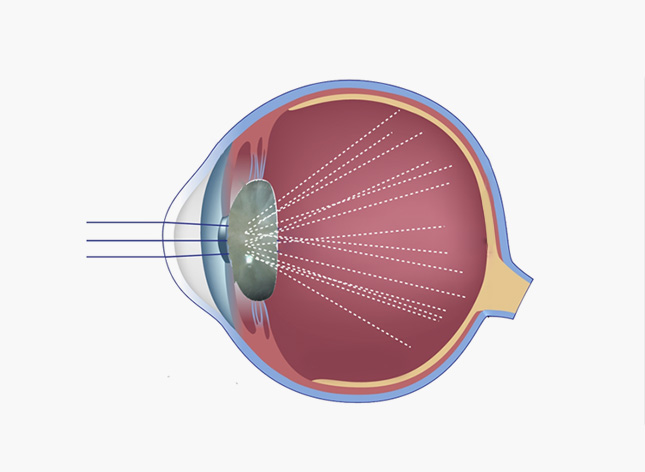
Astigmatism is a common refractive error caused by an irregularly shaped cornea or, less often, an irregularly shaped natural lens inside the eye. Instead of a symmetrical curve like a basketball, an astigmatic cornea is shaped more like a football, so light entering the eye focuses at two different points rather than one. This produces blurred or distorted vision at both near and far distances. Astigmatism treatment in Seoul starts with identifying whether the irregularity is corneal, lenticular, or mixed, since this determines which correction method will work best.
Q. What Are the Symptoms of Astigmatism?
- Blurred or distorted vision at any distance, near or far
- Eye strain, fatigue, or a gritty feeling after reading or screen work
- Frequent squinting to bring objects into focus
- Headaches, especially across the forehead, after visual tasks
- Difficulty with night driving, including glare and starburst patterns around lights
Astigmatism by the Numbers
- ▸ An estimated 1 in 3 people in Korea has clinically significant astigmatism
- ▸ Astigmatism frequently coexists with myopia in over 60% of Korean refractive surgery candidates
- ▸ Uncorrected astigmatism above 1.0 diopter can reduce visual acuity by two or more lines on an eye chart
- ▸ Toric lens and topography-guided laser correction now achieve over 90% patient satisfaction in clinical studies
Q. How Is Astigmatism Corrected?
The simplest correction is prescription glasses or soft toric contact lenses, both of which compensate optically for the irregular curvature without changing the eye itself. Toric lenses are specially weighted to stay properly aligned with each blink, and most patients adapt within days.
For a permanent solution, refractive surgery reshapes the cornea directly. Patients from Yeongdeungpo and Gasan often ask about laser options during their first visit, and we walk through which technique fits their prescription, corneal thickness, and lifestyle.
Q. What Surgery Options Treat Astigmatism in Seoul?
Nunehim Eye Center specializes in TransPRK and 2-Day LASEK, both surface-based laser procedures that reshape the cornea to correct astigmatism together with nearsightedness or farsightedness in one session. We do not perform SMILE LASIK; our topography-guided planning is optimized specifically for these surface ablation techniques, which are well suited to thinner or irregularly shaped Korean corneas. For cataract patients with astigmatism, a toric intraocular lens (IOL) can correct both conditions during the same cataract surgery.
Q. When Should I See a Doctor in Seoul?
- Sudden or rapidly worsening blurred vision
- Vision that distorts more in one eye than the other
- Frequent eye rubbing combined with worsening prescription, which may signal keratoconus
- Halos, glare, or double vision that interferes with night driving
- Headaches or eye strain that persist despite an up-to-date glasses prescription
Whether you commute from Guro, Gwanak, or Yeongdeungpo, same-week appointments are available for new astigmatism symptoms at our Guro-gu clinic.
Mild Astigmatism
Under 1.0 diopter. Often correctable with glasses alone or may not require correction if asymptomatic.
Moderate Astigmatism
1.0–2.0 diopters. Typically needs glasses, toric contacts, or is a strong candidate for laser correction.
High Astigmatism
Above 2.0 diopters. May require custom toric lenses or advanced topography-guided surgical planning.
A Note From Dr. Daniel Baik
“Astigmatism is often dismissed as ‘just needing new glasses,’ but uncorrected astigmatism is one of the most common reasons I see patients from Gwanak and Gasan for chronic headaches and eye strain. A five-minute topography scan tells us exactly how the cornea is shaped, and that precision is what lets us offer the right correction the first time.”
❓ Frequently Asked Questions
Q. Can astigmatism go away on its own?
No. Astigmatism results from a permanently irregular curvature of the cornea or lens, so it does not resolve without correction. It can, however, be fully managed with glasses, contact lenses, or refractive surgery, and mild astigmatism sometimes becomes less noticeable as the eye grows during childhood.
Q. Is astigmatism the same as needing glasses for nearsightedness?
No. Nearsightedness (myopia) means the eye is too long or the cornea too steeply curved, blurring distance vision, while astigmatism is caused by an irregularly shaped cornea or lens that blurs vision at all distances. Many patients in Seoul have both conditions together, which is why a combined refraction and corneal topography exam is important before choosing correction.
Q. Can I get LASIK or PRK if I have astigmatism?
Yes, in most cases. Modern excimer laser platforms used for TransPRK and 2-Day LASEK can correct moderate to high astigmatism together with nearsightedness or farsightedness in a single procedure. Suitability depends on corneal thickness, shape stability on topography, and overall eye health, all of which we check during a pre-surgical workup at our Guro-gu clinic.
Q. Are toric contact lenses hard to get used to?
Most patients adjust within a few days. Toric lenses are designed with a weighted or stabilized zone so they rotate back into position with each blink, and today’s soft toric materials are far more comfortable than older rigid designs. We fit and verify rotation stability in-office before sending patients home with a trial pair.
Q. How often should I get my astigmatism checked?
We recommend an annual eye exam for stable astigmatism, since corneal curvature can shift gradually with age, contact lens wear, or eye rubbing. Patients with keratoconus or irregular astigmatism should be seen more frequently, often every 6 months, to monitor for progression.
Q. Does astigmatism cause headaches or eye strain?
Yes, uncorrected astigmatism is a common cause of eye strain, headaches after reading or screen use, and squinting, because the eye is constantly working to compensate for the blurred, distorted image. Many patients who come to our clinic from Gasan and Gwanak describing chronic headaches are found to have previously undiagnosed astigmatism.
Q. Is astigmatism surgery covered by insurance in Korea?
Diagnostic exams are generally covered under Korean national health insurance, but refractive procedures like TransPRK, 2-Day LASEK, and elective toric IOL upgrades are considered elective and are typically not covered. Our staff can walk you through itemized costs during your consultation.

Book a Consultation
Get an accurate astigmatism diagnosis and personalized treatment plan at Nunehim Eye Center, Guro-gu.
nunehim.com
📍 Visit Nunehim Eye Center — Guro, Seoul
Convenient access from Guro, Gasan, Gwanak & Yeongdeungpo. Near Guro Digital Complex Station (Line 2).
Address
551 Siheung-daero, Guro-gu, Seoul · nunehim.com
Hours
Mon–Fri 09:00–18:30 (lunch 13–14), Sat 09:00–14:00
Languages
Korean & English


Leave a comment