OCT Scan Explained: What This Eye Test Reveals in Seoul
Advanced retinal imaging for patients in Guro, Yeongdeungpo, Gasan & Gwanak
Quick Answer
An OCT scan for eyes in Seoul is a painless, non-contact imaging test that produces cross-sectional pictures of the retina and optic nerve in micron-level detail, revealing early signs of glaucoma, macular degeneration, diabetic retinopathy, and other conditions before symptoms appear. At Nunehim Eye Center in Guro-gu, OCT is a routine part of comprehensive eye exams.
Q. What Is an OCT Scan and How Does It Work?
Optical Coherence Tomography, or OCT, uses light waves rather than X-rays or sound to capture detailed cross-sectional images of the retina, optic nerve, and other eye structures. The technology works similarly to ultrasound, but substitutes light for sound, producing images with far higher resolution — often down to a few microns. An OCT scan for eyes lets your ophthalmologist see individual retinal layers separately, which is essential for catching disease at its earliest, most treatable stage.
Q. What Can an OCT Scan Detect?
- Glaucoma-related thinning of the optic nerve fiber layer
- Age-related macular degeneration, both dry and wet forms
- Diabetic macular edema and diabetic retinopathy
- Epiretinal membrane and macular holes
- Fluid, swelling, or scarring within the retinal layers
OCT Screening Facts
- ▸ OCT can detect glaucoma-related nerve thinning years before a visual field defect appears
- ▸ Diabetic retinopathy affects roughly 1 in 5 long-term diabetic patients in Korea, many without symptoms
- ▸ Age-related macular degeneration is a leading cause of vision loss in Koreans over 60
- ▸ A full OCT scan of both eyes typically takes under 60 seconds to capture
Q. What Conditions Does OCT Screening Catch Early?
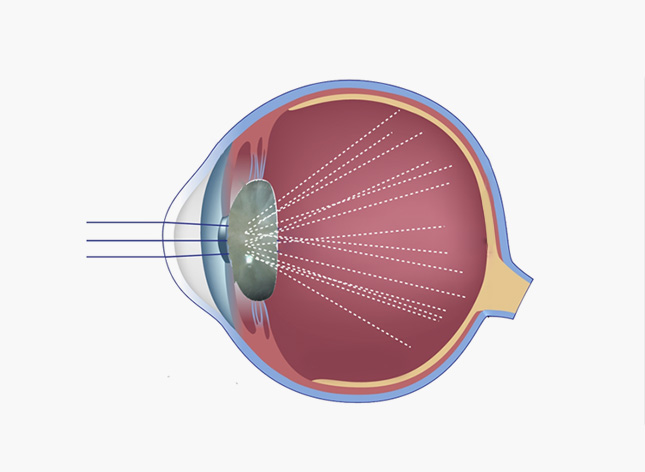
OCT is most valuable for silent, progressive conditions — glaucoma, diabetic retinopathy, and macular degeneration — that cause irreversible damage before a patient notices any change in vision. Regular OCT screening allows us to intervene while treatment can still preserve vision.
We recommend baseline and follow-up OCT scans for patients across Yeongdeungpo and Gasan who have diabetes, high myopia, a family history of glaucoma, or are simply over 40 and due for a comprehensive screening.
Q. What Happens During an OCT Scan Appointment?
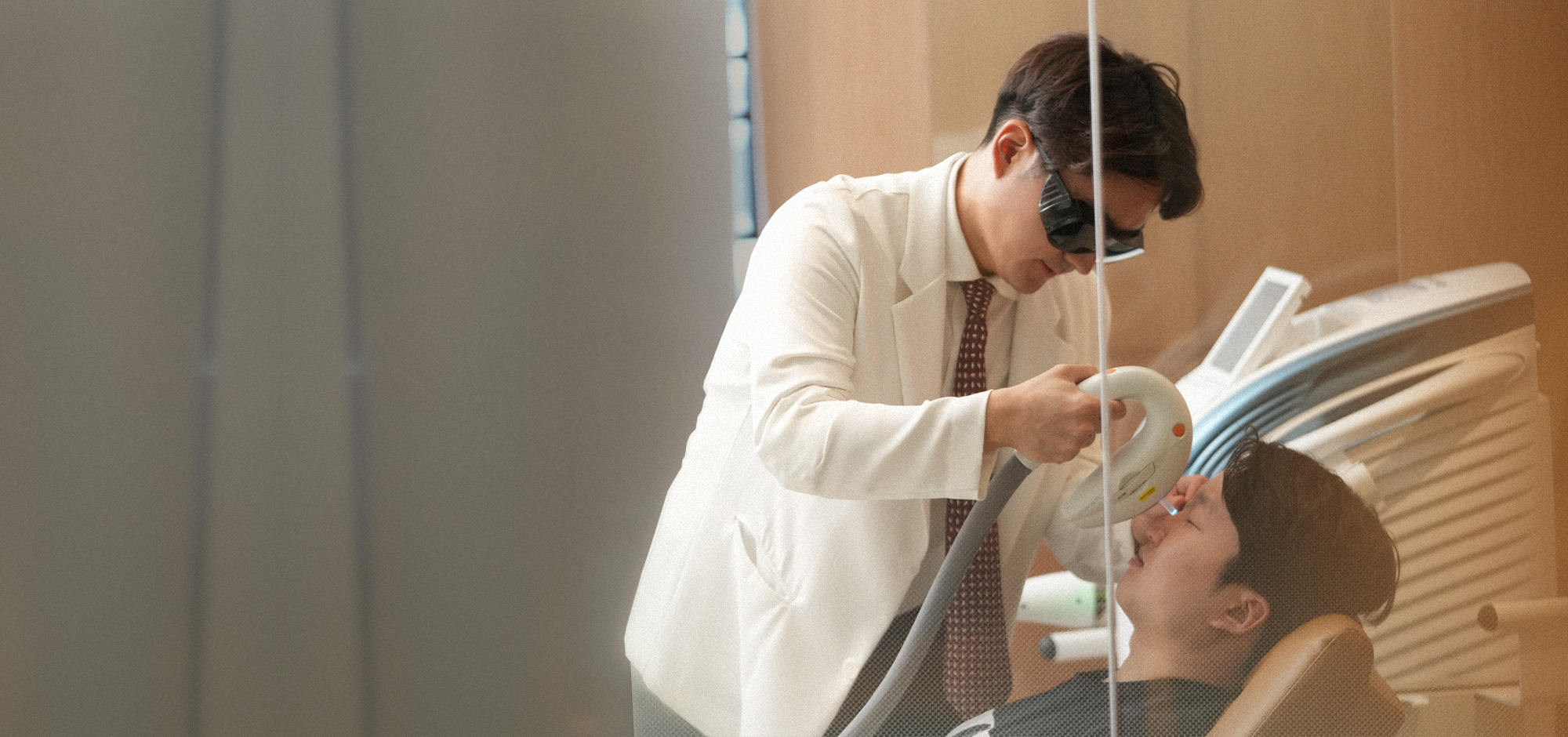
You will be seated at the OCT machine and asked to rest your chin on a support while looking at a small fixation light. The scan itself takes only a few seconds per eye and requires no eye drops, no physical contact with the eye, and no discomfort. Your doctor reviews the resulting retinal layer maps the same day, comparing them to normative data and, if you have prior scans, tracking any change over time.

Q. When Should I Get an OCT Scan in Seoul?
- You have diabetes, regardless of how your vision currently feels
- You have a family history of glaucoma or macular degeneration
- You notice straight lines appearing wavy or distorted (a possible sign of macular disease)
- You have been told your eye pressure is elevated
- You are over 40 and have not had a comprehensive retinal screening recently
Patients from Guro, Gwanak, and Yeongdeungpo can usually be scheduled for OCT screening within the same week at our Guro-gu clinic.
Retinal OCT
Maps the macula layer by layer to detect swelling, fluid, holes, or age-related degeneration.
Optic Nerve OCT
Measures nerve fiber layer thickness around the optic disc — central to glaucoma diagnosis and monitoring.
Anterior Segment OCT
Images the cornea and angle structures, useful for angle-closure glaucoma risk and corneal evaluation.
A Note From Dr. Daniel Baik
“OCT has changed how early we can catch glaucoma and diabetic eye disease. I regularly see patients from Gwanak and Gasan who feel their vision is completely normal, yet the scan shows changes that need attention now, while treatment can still make the biggest difference.”
❓ Frequently Asked Questions
Q. Is an OCT scan the same as a regular eye exam?
No. A routine eye exam checks vision sharpness and general eye health with a light and basic instruments, while an OCT scan for eyes uses light-based cross-sectional imaging to see individual layers of the retina and optic nerve in micron-level detail — detail that is impossible to see with the naked eye, even through a slit lamp.
Q. Does an OCT scan hurt or require eye contact?
No. OCT is completely non-contact and painless. You simply rest your chin on a support and look at a fixation target while the machine scans, and the entire process takes only a few seconds per eye. No numbing drops or physical contact with the eye are required.
Q. Do I need to have my pupils dilated for an OCT scan?
Not always. Modern OCT machines can capture usable images through an undilated pupil in most patients, though your doctor may still recommend dilation for a more complete view of the peripheral retina, especially if other findings suggest a need for a wider examination.
Q. How often should I get an OCT scan in Seoul?
This depends on your risk factors. Patients with glaucoma, diabetes, or a family history of macular degeneration are often scanned annually or more frequently to track subtle changes over time, while healthy patients without risk factors may only need a baseline scan every few years starting around age 40.
Q. Can OCT detect glaucoma before vision loss occurs?
Yes, this is one of its most valuable uses. OCT measures the thickness of the retinal nerve fiber layer around the optic nerve, and thinning can be detected years before a patient notices any blind spots, which is why OCT scans are central to early glaucoma screening at our clinic.
Q. Is OCT useful for diabetic patients even if their vision feels normal?
Yes. Diabetic macular edema and early diabetic retinopathy can develop without any noticeable vision change, and OCT can pick up microscopic fluid or swelling in the retina before symptoms appear, which is why annual OCT screening is recommended for diabetic patients regardless of how their vision feels.
Q. Is the cost of an OCT scan covered by insurance in Korea?
OCT scans performed for diagnostic reasons — such as monitoring glaucoma, diabetic retinopathy, or macular disease — are often partially covered under Korean national health insurance when medically indicated, while scans performed purely for elective screening may carry an out-of-pocket cost. Our front desk can confirm coverage before your visit.

Book a Consultation
Schedule an OCT scan and comprehensive eye screening at Nunehim Eye Center, Guro-gu.
nunehim.com
📍 Visit Nunehim Eye Center — Guro, Seoul
Convenient access from Guro, Gasan, Gwanak & Yeongdeungpo. Near Guro Digital Complex Station (Line 2).
Address
551 Siheung-daero, Guro-gu, Seoul · nunehim.com
Hours
Mon–Fri 09:00–18:30 (lunch 13–14), Sat 09:00–14:00
Languages
Korean & English


Leave a comment