Clareon PanOptix Pro in Seoul: What Changed From the Original PanOptix? The 94% Light Utilization Explained
What the new trifocal lens does, and does not, promise for cataract and presbyopia patients
Quick Answer
Clareon PanOptix Pro Seoul: Clareon PanOptix Pro is a new trifocal intraocular lens from Alcon, officially launched in Korea in July 2026. It keeps the far, intermediate and near focus design of the original PanOptix but, according to Alcon, uses light more efficiently: about 94% versus about 88%. That does not mean 94% visual acuity, and it does not mean halos are cut in half. Whether it suits you depends on a detailed eye exam; you can book one at Nunehim Eye Center in Guro, Seoul.
By Dr. Daniel Baik, board-certified ophthalmologist at Nunehim Eye Center on Siheung-daero, Guro-gu. Patients from Yeongdeungpo, Gasan and Gwanak regularly ask us three questions: can cataract surgery also fix presbyopia, will a multifocal lens cause night glare, and how does the new lens differ from the old one? This guide answers each. For the basics, see our cataract surgery guide for expats in Seoul.
Q. What is Clareon PanOptix Pro?
An intraocular lens (IOL) replaces your cloudy natural lens during cataract surgery. Young eyes focus by changing the shape of the natural lens; with age that ability fades, causing presbyopia (trouble reading up close), and the lens may cloud into a cataract. The IOL you choose affects how much you rely on glasses afterwards.
Clareon PanOptix Pro is a diffractive trifocal IOL designed to support three working distances and reduce dependence on glasses at each:
- Far: driving, TV, road signs, recognizing faces at a distance
- Intermediate (about 60 cm): computer monitor, laptop, desk work
- Near (about 40 cm): smartphone, books, documents
These are design targets. They do not guarantee that every patient sees sharply without glasses at every distance.
Q. Is it a trifocal or a quadrifocal lens?
The optics use a quadrifocal diffractive principle, but the light of one focus is redirected to the distance focus. Clinically, it is classified as a trifocal lens with three main focal points.
Q. What does ENLIGHTEN NXT change, and what does 94% light utilization mean?
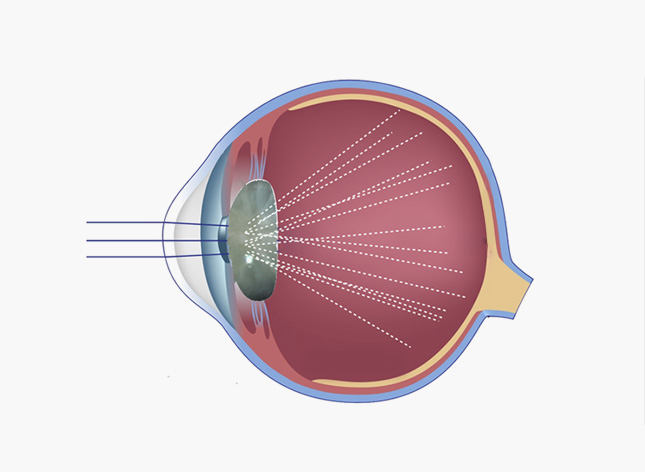
A monofocal lens concentrates light on one focus. A diffractive trifocal lens splits incoming light between several foci, and some of that light inevitably does not contribute to a useful image. The Pro keeps the original focus structure and uses Alcon’s ENLIGHTEN NXT optical technology to reduce that loss.
Manufacturer figures at a glance
- ▸ Original Clareon PanOptix: about 88% light utilization, about 12% unused
- ▸ Clareon PanOptix Pro: about 94% light utilization, about 6% unused
- ▸ Unused light is roughly halved in relative terms, per Alcon
- ▸ Alcon optical testing reports roughly 16% higher image-contrast (MTF) in certain far-to-intermediate conditions
Please read these numbers carefully. 94% light utilization is not 94% vision or 94% satisfaction. Halving unused light in optical tests does not mean halving the halos you notice. A 16% higher optical contrast metric does not mean a 16% better eye chart or contrast sensitivity result. These figures come from the manufacturer’s optical testing and simulation, and a comparative presentation at ESCRS 2026 likewise noted the optical promise while calling for prospective clinical studies. Real-world vision also depends on the cornea, retina, pupil size, residual refractive error and dry eye.
Q. Does the Pro cause fewer halos and glare?
Possibly, but it is not proven. Diffractive multifocal lenses, including the original PanOptix, can cause halos around streetlights and headlights, glare, and starbursts. The Pro reduces unused light optically, which may help visual quality, yet optical test results and what patients feel at night are separate things.
Some people adapt over time, and some remain bothered. If you drive a lot at night or are sensitive to glare, discuss monofocal and other lens options as well. Commuters working in the Guro and Gasan digital complexes who drive home in the dark should raise this at the consult.
Q. How does the Pro compare with the original PanOptix and a monofocal lens?
| Item | Monofocal IOL | Clareon PanOptix | Clareon PanOptix Pro |
|---|---|---|---|
| Focus | Mainly one distance | Far, intermediate, near | Far, intermediate, near |
| Optical design | Monofocal | Diffractive trifocal | Trifocal with ENLIGHTEN NXT |
| Light utilization (manufacturer data) | Not directly comparable | About 88% | About 94% |
| Light not used for focus | Not directly comparable | About 12% | About 6% |
| Night halos and glare | Generally fewer | Can occur | Can occur |
| Cost | Standard covered lens available | Premium lens, self-pay | Premium lens, self-pay |
Light figures are manufacturer-reported; monofocal and multifocal lenses work on different optical principles, so direct numerical comparison has limits. The key point is that the Pro is an efficiency improvement on an existing trifocal design, not a different focus concept.
Q. Who may suit a trifocal lens, and who should be careful?
A trifocal lens may suit people with cataract and presbyopia who want less dependence on glasses at far, computer and phone distances, provided the cornea, retina and optic nerve are healthy. Office workers often care as much about the 60 cm monitor distance as about far vision, but monitor distance varies, so the lens should be matched to the distances you use most.
Extra caution is needed with retinal disease (macular degeneration, diabetic retinopathy), glaucoma with optic nerve damage, significant dry eye, irregular cornea or previous refractive surgery, frequent night driving, and expecting never to need glasses.
Q. What tests should I have before choosing a lens?
- Corneal topography and curvature, to assess astigmatism and irregularity
- Biometry (axial length) for lens power calculation
- Retinal OCT, to screen the macula for disease
- Optic nerve assessment for glaucoma
- Dry eye and tear film evaluation
- Pupil and refraction assessment
We also ask about your job, hobbies and driving habits. The newest lens is not automatically the best one for you.
Q. How can expats get a Clareon PanOptix Pro consultation in Seoul?
Book through Naver Booking or request an English consultation at Nunehim Eye Center. No referral is needed. Bring your passport or ARC, your current glasses, medication list and any previous eye records. Premium multifocal lenses are generally self-pay in Korea, while parts of cataract surgery may be covered by national health insurance if you qualify medically; coverage of private insurance depends on your policy. Ask the clinic for a current quote and check with your insurer before surgery. Our clinic is reachable from Yeongdeungpo, Gasan and Gwanak.
Q. When should I see a doctor in Seoul urgently?
- Sudden vision loss or a curtain over your vision
- New flashes of light or a shower of floaters
- Severe eye pain, redness or nausea
- Worsening vision, pain or redness after eye surgery
Dr. Daniel Baik’s tip
“Measure your real working distances before the consult: how far your monitor is from your eyes, how you hold your phone, and how far you read. Bring a photo of your desk. A lens that suits a 60 cm monitor may be wrong for an 80 cm display, and that detail matters more than the lens name.” Dr. Daniel Baik, board-certified ophthalmologist
❓ Frequently Asked Questions
Q. How is the Pro different from the original PanOptix?
It keeps the trifocal structure but, per manufacturer testing, raises light utilization from about 88% to about 94% and reduces unused light from about 12% to about 6% using ENLIGHTEN NXT.
Q. Is it trifocal or quadrifocal?
Officially trifocal. It uses a quadrifocal diffractive principle but redirects light to the far, intermediate and near foci.
Q. Will halos be cut in half?
That cannot be assumed. The roughly 50% reduction refers to unused light in optical tests, not to the glare and halos patients perceive at night.
Q. Will I never need reading glasses?
The aim is less dependence on glasses, but it is not guaranteed. Very small print, dim light or particular distances may still need glasses.
Q. Can I have it after LASIK or LASEK?
Previous refractive surgery does not automatically rule it out, but the cornea and power calculation need extra careful evaluation.
Q. Can it be used if I do not have a cataract?
Replacing a clear lens to correct presbyopia is possible in some cases but irreversible. Age, lens status, retinal risk (especially in high myopia) and expected outcomes need careful review.
Q. Is the Pro covered by insurance, and what does it cost?
Multifocal lenses are generally self-pay. Ask the clinic for a current quote and confirm private insurance coverage with your insurer before surgery.

Related reading
- Cataract surgery in Seoul: symptoms, lens options and what to expect
- Presbyopia surgery in Seoul: LASIK, LASEK and multifocal or EDOF lenses
- How often should you get an eye exam? A guide for expats in Seoul
This article is for general information. Lens characteristics, suitability and outcomes depend on each person’s eyes, and surgery decisions should follow an examination by an ophthalmologist.
Book a Consultation
Discuss cataract and presbyopia lens options in English at Nunehim Eye Center, Guro.
📍 Visit Nunehim Eye Center — Guro, Seoul
Convenient access from Guro, Gasan, Gwanak and Yeongdeungpo. Near Guro Digital Complex Station (Line 2).
Address
551 Siheung-daero, Guro-gu, Seoul
nunehim.com
Hours
Mon–Fri 09:00–18:30 (lunch 13–14)
Sat 09:00–14:00
Languages
Korean & English


Leave a Reply