Buying Glasses in Korea as a Foreigner: Prescription, Eye Exam and What an Optical Shop Cannot Check
An English-speaking ophthalmologist’s guide for expats in Guro, Gasan, Yeongdeungpo and Gwanak — how Korean optical shops work, how to read your prescription, and when you need a real eye exam first
Quick Answer
Buying glasses in Korea is fast and convenient: for adults, a licensed optician (안경사) at an optical shop (안경원) can measure your refraction and make glasses — often the same day — without a doctor’s prescription. But an optical-shop test only finds the lens that makes letters sharpest. It cannot dilate your pupils, diagnose glaucoma, or examine your retina and optic nerve. See an ophthalmologist first if your vision changed suddenly or in one eye only, if new glasses give you headaches, if the glasses are for a young child, or if you have not had a full eye exam in the last two years. At Nunehim Eye Center in Guro — a short trip from Gasan, Yeongdeungpo and Gwanak — Dr. Daniel Baik, a board-certified ophthalmologist, performs the exam and writes your glasses prescription in English.
Q. How does buying glasses in Korea work for foreigners?
There are two routes to buying glasses in Korea. The first is to walk straight into an optical shop. Korean opticians are licensed health professionals under the Medical Service Technologists Act, and for adults they are allowed to measure refraction and dispense corrective glasses without a prescription. The second route is to have an eye examination at an ophthalmology clinic such as Nunehim Eye Center (nunehim.com), receive a written glasses prescription (안경처방전), and take it to any optical shop you like. Most Korean eye clinics do not sell frames themselves, so the prescription is yours to use anywhere — in Guro, in Yeongdeungpo’s shopping districts, or back home.
The one important legal exception is young children: under Korean rules, glasses for children aged six and under should be made from an ophthalmologist’s prescription, because children’s focusing power can hide farsightedness that only an exam with dilating (cycloplegic) drops reveals.
Whichever route you take, your prescription uses international notation. SPH (구면) is the main nearsighted (minus) or farsighted (plus) power; CYL (난시) and AXIS (축) describe astigmatism; ADD (가입도) is the extra reading power for progressive or bifocal lenses after about age 40; and PD (동공간거리) is the distance between your pupils. Korean prescriptions usually write astigmatism in minus-cylinder form. If your home prescription is in plus-cylinder form, the numbers will look different but describe the same lens — the optician simply transposes it.
Q. What can a Korean optical shop check — and what can it not check?
A good optical shop will measure your eyes with an autorefractor, refine the result with trial lenses (subjective refraction), read your old glasses on a lensmeter, and measure PD and fitting height for your chosen frame. That is excellent for finding a comfortable lens. What it is not designed to do is explain why your vision changed. An optical shop cannot:
- Perform a cycloplegic (dilating-drop) refraction, which is essential for children and for adults with hidden farsightedness or focusing spasm.
- Examine the optic nerve, measure eye pressure for diagnosis, or run visual-field tests — the tools used to detect glaucoma, which usually has no symptoms until late.
- Look at the retina and macula through a dilated pupil to find diabetic retinopathy, macular degeneration, epiretinal membrane or a retinal tear.
- Diagnose early cataract, keratoconus or corneal scarring — common reasons a prescription suddenly “stops working”.
- Assess dry eye, inflammation or infection, prescribe eye drops, or issue a medical certificate.
Q. What are the signs you need an eye exam, not just new glasses?
- Vision dropped in one eye only, or your prescription changed noticeably within a year as an adult.
- Straight lines look wavy or bent, or there is a blurry or dark spot in the centre of your vision.
- Glare and halos around headlights at night, or colours looking faded — typical of developing cataract.
- New glasses still feel wrong after two weeks: headaches, eye strain, double vision or a “pulling” sensation.
- Your optician says they cannot get you to see clearly even with the best lens (vision not correctable to normal).
- You have diabetes, high myopia (around −6.00 or stronger), a family history of glaucoma, or you are over 40 and have never had a full eye exam.
📊 Why the prescription is only half the story
▸ A study of 19-year-old men in Seoul found myopia in 96.5% of them — one of the highest rates ever reported (Jung et al., Investigative Ophthalmology & Visual Science, 2012).
▸ The WHO World Report on Vision (2019) estimates that at least 2.2 billion people have a near or distance vision impairment, and in at least 1 billion of them it could have been prevented or has yet to be addressed.
▸ Holden et al. (Ophthalmology, 2016) projected that about half of the world’s population — nearly 5 billion people — will be myopic by 2050.
▸ The same analysis projected nearly 1 billion people with high myopia by 2050, the group at greatest risk of retinal detachment, myopic maculopathy and glaucoma — conditions an optical shop cannot screen for.
Q. Which lenses and options should you choose when buying glasses in Korea?
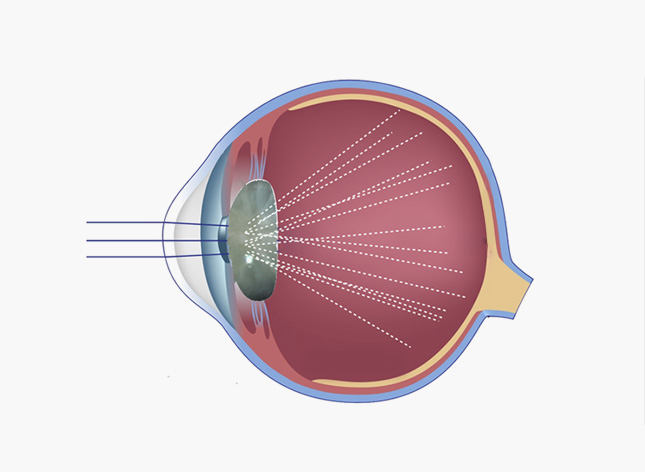
Korean optical shops stock a wide range of domestic and international lenses. The biggest decision is lens index: higher-index lenses (1.67 or 1.74) are thinner and lighter for strong prescriptions, while 1.50–1.60 is usually enough for mild ones. Common single-vision lenses are often in stock and ready the same day; high-index lenses, strong astigmatism, progressives and special coatings may need to be ordered and take several days. Ask for the lens brand, index and coatings in writing, and keep your old pair until the new one feels right.
For screen-heavy jobs, a dedicated computer or “office” prescription often helps more than a blue-light coating — the American Academy of Ophthalmology does not recommend blue-light glasses for digital eye strain, which is mainly caused by reduced blinking and sustained near focus. If you are over 40, progressive lenses need accurate fitting height and PD, so take time with the fitting. For children with progressing myopia, ordinary glasses correct blur but do not slow progression; options such as OK lens (orthokeratology), low-dose atropine or myopia-control spectacle lenses should be discussed with an ophthalmologist.
Q. How do expats get an English-speaking eye exam and glasses prescription in Seoul?
Booking: reserve on Naver Booking, or send us a message on our KakaoTalk channel — you can write in English. Patients come from Guro, Gasan Digital Complex, Yeongdeungpo and Gwanak, and many book around lunch or Saturday mornings. What to bring: your passport or ARC (Alien Registration Card), your current glasses, any written prescription from home, and records of previous eye surgery or eye disease. If you wear soft contact lenses, wear glasses on the day if you can, because lenses can temporarily change corneal measurements.
Insurance and cost: foreigners enrolled in Korea’s National Health Insurance (NHIS) generally pay a copayment for medically necessary eye examinations, while people without NHIS pay the self-pay rate. Glasses and frames themselves are bought separately at the optical shop and are generally not covered for adults. Coverage depends on the tests needed, so ask the clinic for a current quote. Visit flow: registration, vision and refraction testing, eye pressure, an examination by Dr. Baik at the slit lamp, dilation if needed (plan for blurred near vision and light sensitivity for a few hours), then an English explanation and a printed prescription.
Q. When should I see a doctor in Seoul?
Do not wait to “just get new glasses” if you notice any of the following — see an eye doctor promptly, and the same day for sudden symptoms:
- Sudden loss or blurring of vision in one or both eyes.
- A shower of new floaters, flashes of light, or a curtain or shadow spreading across your vision.
- Sudden double vision, or a droopy eyelid with eye pain or headache.
- A red, painful eye with blurred vision or halos around lights.
- Distorted or wavy central vision.
- Contact-lens wearers with pain, redness and light sensitivity — remove the lenses and do not just switch to glasses.
Step 1 · Eye exam & prescription
Refraction plus a health check of the front and back of the eye. Children and first-time high-myopia patients may need dilating drops. You leave with a written prescription in standard notation.
Step 2 · At the optical shop
Choose a frame that sits your pupils near the lens centre, then lens index and coatings. The optician measures PD and fitting height. Ask for the lens details in writing.
Step 3 · Adaptation & follow-up
Allow up to two weeks to adapt, longer for progressives. If headaches, strain or double vision persist, have the optician check the glasses first, then return for an eye exam.
💬 Dr. Daniel Baik’s tip
“Before you pay for new lenses, ask the optician to write down the sphere, cylinder, axis and PD they measured, and compare them with your old glasses. If the power changed by more than about 0.50 in one eye only, or your astigmatism jumped noticeably, pause and get an eye exam first — an uneven change is often the first clue to early cataract, keratoconus or a macular problem rather than ‘just a new prescription’. And if you are over 40, consider a second pair for computer distance; one pair rarely does everything well.”
— Dr. Daniel Baik, board-certified ophthalmologist, Nunehim Eye Center, Guro
❓ Frequently Asked Questions
Q. Do I need a prescription to buy glasses in Korea?
Not as an adult. A licensed optician can measure your eyes and make glasses without a doctor’s prescription. Glasses for children aged six and under should be made from an ophthalmologist’s prescription. Even for adults, an ophthalmologist’s exam is the better starting point if this is your first pair in Korea, your vision changed suddenly, or you have not had a full eye health check recently.
Q. Can I use my prescription from home when buying glasses in Korea?
Yes. Sphere, cylinder, axis, add and PD are international notation, so any Korean optical shop can read a written prescription from your home country. Check its date — adult prescriptions are usually updated every one to two years, and children’s more often. If PD is missing, the optician can measure it. Plus- and minus-cylinder forms look different but describe the same lens.
Q. How long does it take to get glasses made in Korea?
Common single-vision prescriptions are often ready the same day because the lenses are in stock. High-index lenses, strong astigmatism, progressive lenses and special coatings may need to be ordered and can take several days. Ask for a pickup date when you order.
Q. Does Korean National Health Insurance cover glasses?
For adults, glasses and frames are generally paid out of pocket. Medically necessary eye examinations at a clinic are covered by NHIS with a copayment if you are enrolled. NHIS has a limited reimbursement for glasses for young children diagnosed with conditions such as amblyopia or strabismus; ask the clinic about current eligibility and the paperwork needed.
Q. Why do my new glasses give me headaches?
Mild strain for the first few days is normal, especially after an astigmatism change or with first-time progressives. If it lasts beyond about two weeks, first ask the optician to verify the lens power, axis, PD and optical centres against your prescription. If the glasses match, book an eye exam — persistent symptoms can come from hidden farsightedness, an eye-alignment (binocular vision) problem or an incorrect prescription.
Q. Does my child need a dilated eye exam before getting glasses?
In most cases, yes. Children can focus strongly enough to hide farsightedness and make nearsightedness look worse than it is, so an exam with cycloplegic drops gives the true prescription. It also checks for amblyopia (lazy eye) and strabismus. If your child’s myopia is increasing every year, ask about myopia control such as OK lens rather than simply stronger glasses.
Q. Should I buy blue-light glasses for screen work?
They are optional, not a treatment. The American Academy of Ophthalmology does not recommend blue-light glasses for digital eye strain. An accurate prescription, a computer-distance pair if you are over 40, regular breaks (the 20-20-20 rule), and treating dry eye usually help more.

📚 Related reading
- Eye Exam Cost in Korea for Foreigners: NHIS vs Self-Pay and How to Book in English
- Presbyopia Treatment in Seoul Without Surgery: Progressives, Office Lenses and More
- Contact Lens Care in Seoul: The Complete Daily-Wear Guide for Expats
Book a Consultation
Get an English-speaking eye exam and a written glasses prescription before you visit the optical shop — convenient for patients from Guro, Gasan, Yeongdeungpo and Gwanak.
📍 Visit Nunehim Eye Center — Guro, Seoul
Nunehim Eye Center is in Guro-gu, with easy subway and bus access from Gasan Digital Complex, Gwanak, Yeongdeungpo and the rest of Guro. Book online, or message us on KakaoTalk in English before your visit.
📌 Address
551 Siheung-daero, Guro-gu, Seoul
nunehim.com
🕘 Hours
Mon–Fri 09:00–18:30 (lunch 13:00–14:00)
Sat 09:00–14:00
🗣️ Languages
Korean & English


Leave a Reply